




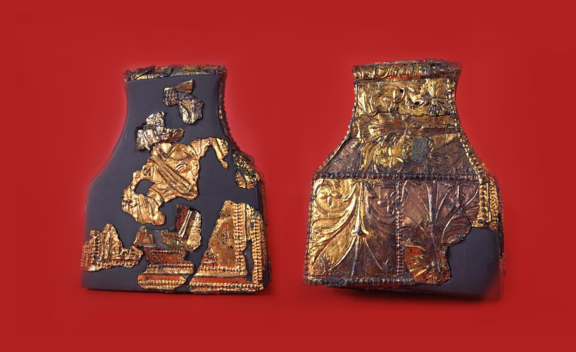
This remarkable artifact, dating from the late Saxon period, approximately between 800 and 920 AD, was discovered during excavations conducted by the Archaeological Section of the Winchester Museum Service in Sussex Street, Winchester, in 1976.
Comprising thin gilded sheets of copper alloy affixed to a beechwood core, this object is nearly unique in England because it was found in its archaeological context rather than preserved as a "church slab." Its discovery is quite intriguing as it was located on top of a decayed layer of sewage within a cesspool, a rather perplexing placement. Given its potential use as a portable altar during a time when the parish structure of Winchester was not yet fully established, one might speculate about nefarious activities like vandalism or theft. However, it's worth noting that despite one of the gilded plates being torn off, it was carefully folded and placed in a hole near the main discovery site. Furthermore, the relic it once contained is still present inside, as confirmed by an X-ray taken during the preservation of the site.
Upon closer examination of its structure, it was determined that the reliquary was not designed to be opened during use. Therefore, a decision was made not to dismantle it to inspect the relic. The relic itself did not appear to be a human bone and could have been a container for a small amount of hair or a tiny fragment of what is presumed to be the One True Cross. Alternatively, there is an unburned piece of skin protruding from the wooden core's boards, likely the remnants of a parchment label used to prevent confusion when multiple relics were stored in the same location.
The reliquary has a wallet-like shape and is adorned with embossed decorations. The front plate features a seated figure of Christ, while the back plate displays a row of tubular tree stems resembling acanthus leaves, often interpreted as representing the tree of life. Although it predates the renowned Winchester School of Late Saxon art, the style of decoration suggests continental influence.