



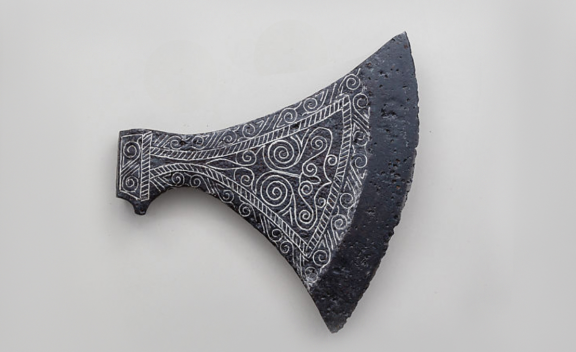
Dating from the 11th to 12th centuries, this Scandinavian axe holds a special place in the Weapons and Armor Division's collection, despite the relatively limited number of early medieval European armor and weapons within the museum's holdings, especially those with significant decoration or in unexcavated condition. This particular axe is a notable addition to the collection as a splendid exhibit from the medieval period, marking the first elaborately decorated Viking axe to be included in the permanent collection.
During the Viking era, decorated weapons, including swords, axes, and spears, were highly prized possessions for Viking men. These weapons served not only as functional tools for combat but also as symbols of their social rank and status within society. The axe in question serves as an exemplary representation of the broad axe form, featuring a rare and noteworthy voluminous scroll ornament that has been remarkably preserved and is richly adorned with silver wire inlay.
The construction and design of this axe adhere to the defining characteristics of its type. The cutting edge, or chisel, forms an arc from the toe to the heel, while the upper edge of the body is slightly longer than the lower edge, creating an asymmetrical shift toward the toe. Both edges taper into a short neck, which then transitions to the bell. The lower edge of the bell transitions into a short, rounded point or lapta. Besides the wide flat band running along both sides of the cutting edge, the entire axe head is adorned with silver wire inlay, featuring intricate scroll motifs and linear patterns, adding to its aesthetic appeal and historical significance.