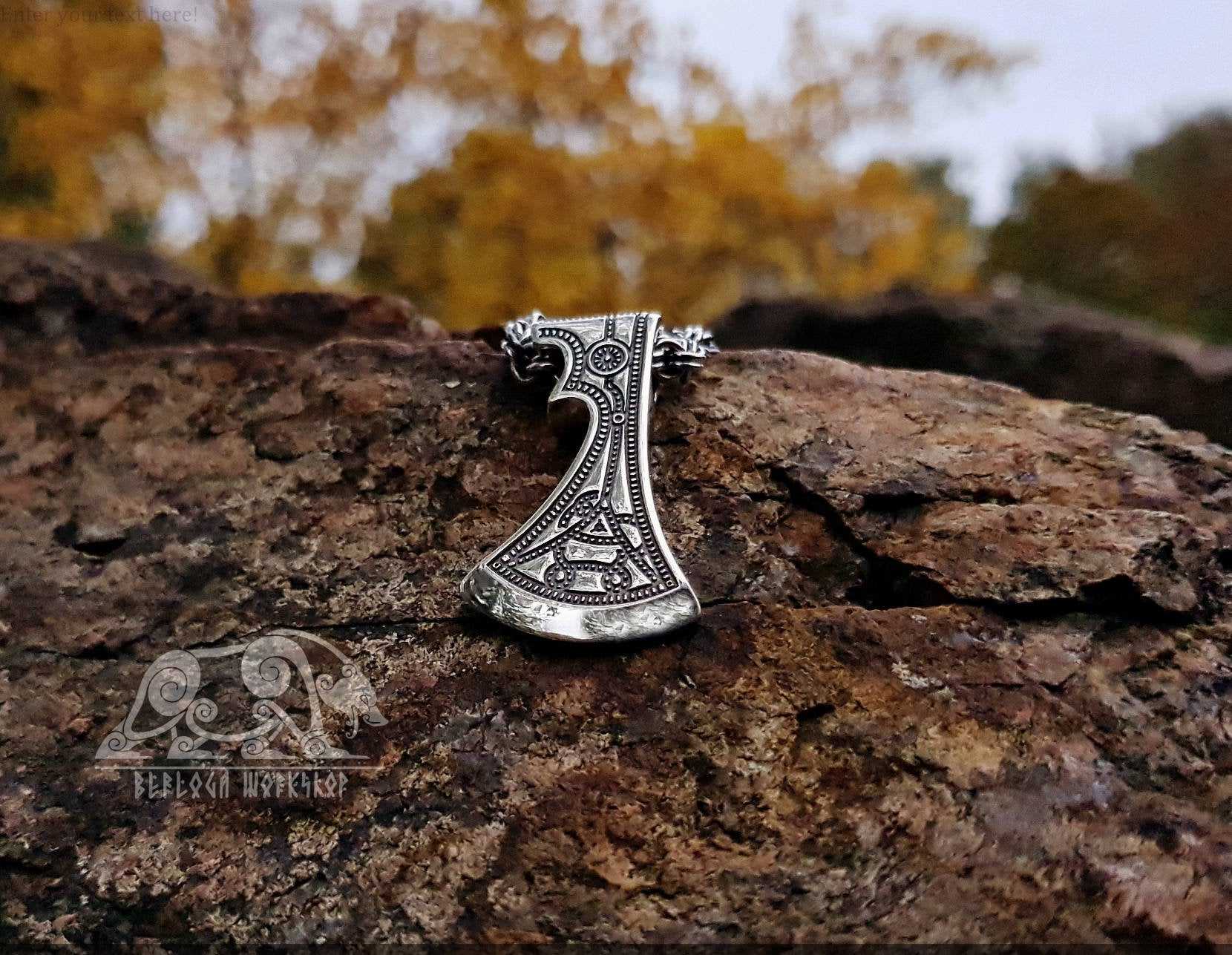


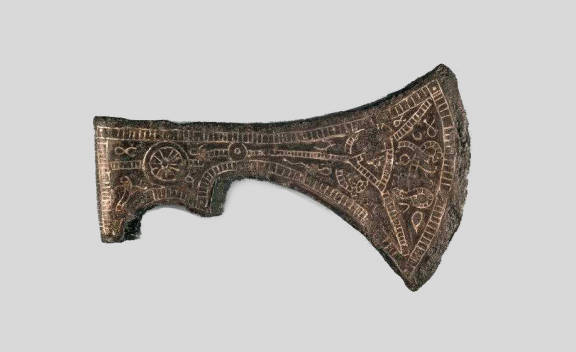
The British Museum houses a decorated head of a 7th-century Merovingian battle axe, which is currently on display. This axe features an iron tip with an extended, asymmetrical triangular blade. Both sides of the blade and its tip are adorned with intricate silver inlaid geometric motifs. The axe head also includes a subrectangular socket designed to attach to a shaft.
The acquisition of this artifact was made possible with the assistance of the Christy Trust during an Antiquities Sale. It was part of the estate of the late Dacre Kenrick Edwards, Esq., and others, who had ownership through Messrs. Christy in London, with the purchase taking place on April 26, 1961.
Battle axes were commonplace in Europe during the migration period and the subsequent Viking Age. They are famously depicted in the 11th-century Bayeux Tapestry, showing Norman mounted knights in combat against Anglo-Saxon infantrymen. These axes continued to be used throughout the Middle Ages. Although their popularity waned in the 12th, 13th, and 14th centuries, they did not vanish entirely. For instance, Robert I of Scotland famously employed one to defeat Sir Henry de Bohun in single combat at the outset of the Battle of Bannockburn in 1314. In the 15th century, they experienced a resurgence in usage among heavily armored horsemen.
Most medieval European battle axes featured a sleeved tip, which meant the broader end of the blade had a hole to accommodate a wooden handle. Some also included langets—long strips of metal attached to the front sides of the handle to protect it from damage during combat. Occasionally, the cheeks of the axe were adorned with engravings, etchings, perforations, or decorative inlays. In later periods, battle axes tended to be entirely made of metal. Variants of the basic battle axe form included medieval weapons like the halberd and axe.