



Cultural Background/Time Period: Carolingian (9th century)
Excavation Location/Discovery Site: Europe, British Isles, England, Lancashire, Halton Moor
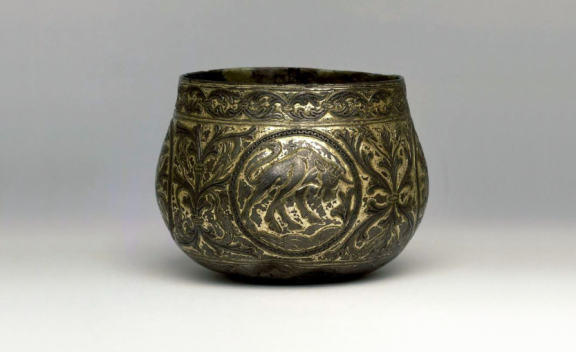
Description: This artifact is a silver-gilt cup or bowl from the Carolingian period, specifically from the 9th century. The cup is richly ornamented with embossed medallions, each containing an animal figure separated by conventional foliate patterns.
Within the decorative design, four medallions are bordered by bands featuring wavy patterns. Two of these medallions depict the figure of a lion, facing to the right with its mouth open and its forked tail raised up. The lion is shown crossing over a stylized plant, with foliage appearing both above and below the animal, as well as on its chest and under its tail. Alternating with these two lion medallions, the other two medallions represent the figure of a bull with a humpback and a forked tail. The bull leans against a piece of stylized foliage, also on a wavy ground.
Four gaps in the ornamentation are occupied by formal plants with rayed branches, from which four dog-like heads emerge, biting the foliage. While the design of each plant is identical to its opposite counterpart, it may vary slightly from the plants closest to it. Additional bands of common leaf curls encircle the lip of the cup and appear below it. These bands also feature transverse collars.
Both the background and the interior of the cup are gilded, and traces of gilding are also present on the ornamentation. However, one side of the rim and the upper part of the body are missing, and the bowl shows some signs of wear and fraying at the bottom. Notably, the cup's foot and lid are missing, leaving us with a fragmentary yet remarkable example of Carolingian craftsmanship.