



School/Style: Winchester style
Cultural Background/Time Period: Late Anglo-Saxon (Mid-10th Century)
Origin/Discovery Location: Europe, British Isles, England, Kent, Canterbury (Kent), Palace Street (northern end)
Materials Used: Copper alloy, silver, niello
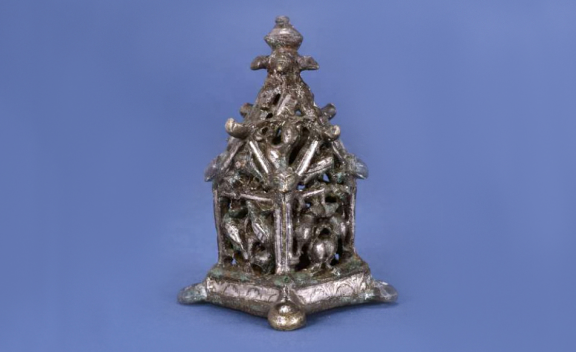
Description: This openwork censer-cover represents the Winchester style, characterized by its intricate and ornate design, and belongs to the Late Anglo-Saxon period, specifically from the mid-10th century. The censer-cover has an architectural shape reminiscent of a square church tower.
Key features of this censer-cover include:
1. Plinth at the Base: At the base of the censer-cover, there is a plinth.
2. Silver Inlay: On each side of the plinth, subrectangular blackened silver plates decorated with acanthus ornamentation are inserted.
3. Suspended Chain: At each corner of the plinth, there is a perforated ledge through which passes a narrow rod attached to a suspended chain. This chain allows the lid to be raised to fill the bowl with incense.
4. Inlaid Silver Strips: The frames surrounding the panels are adorned with inlaid blackened silver strips.
5. Depictions of Animals and Birds: Four rectangular side panels depict pairs of animals or birds. Their bodies are decorated with blackened silver plates, and the animals alternately complement or oppose each other. One of the panels is also adorned with acanthus ornamentation.
6. Triangular Pediments: Above the panels, there are triangular pediments, also framed in blackened silver bands. Three of the pediments show bent animals, while the fourth depicts a bird. Originally, these images were inlaid with silver.
7. Hipped Roof: The hipped roof consists of four diamond-shaped panels. Three of these panels contain two intertwined creatures, while the fourth shows a bird and an animal intertwined together. The wings of the bird and the thighs of the animals are inlaid with silver plates.
8. Gargoyle-like Heads: The heads of the lower creatures protrude like gargoyles from the corners of the building.
9. Heads and Biconical Headpiece: The heads of the three animals and the bird are located at the top of each panel and face outward, just below the biconical headpiece, which is inlaid with a broad band of silver.
10. Tails with Toothed Leaves: The tails of the animals in these panels are intertwined and terminate in a protruding toothed leaf at the top of each pediment.
This censer-cover is a remarkable example of the Winchester style's intricate and rich ornamentation, showcasing the artistic sophistication of the Late Anglo-Saxon period in the mid-10th century.