



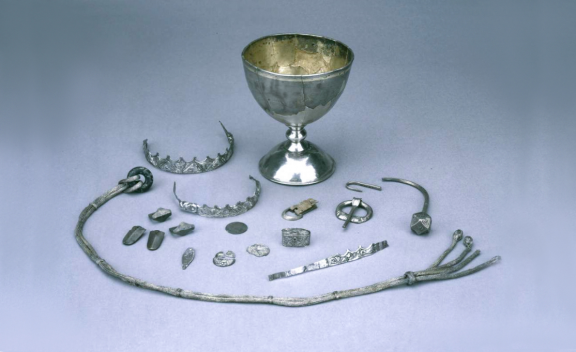
This silver drinking horn band, created in the Trewhiddle style during the Late Anglo-Saxon period around the 9th century (specifically circa 868), is part of the Trewhiddle hoard and was discovered in St Austell, Cornwall, within the British Isles.
The band features two fields of intricate blackened animal and foliate motifs on either side of the opening, along with a serrated edge.
In the first field, which has a subrectangular shape with an arched base, there's a delicate foliate scroll. On either side of a curved stem with extended ends, you can find three leaves. Each leaf and terminal is adorned with two notches along the outer edge. In the lower left corner of this field, there's a forked motif resembling the head of an animal, also featuring two short notches in the thicker part.
The second field is dominated by a similar animal motif, although it is depicted upside down. The head of the animal is turned so that the muzzle is parallel to the upper part of the mount. There's a bump above the eye, and while the lower jaw is broken, there's a suspected ear. The animal has a tail and three legs, one of which seems to pass through the body, and each leg has three toes. To the left of this panel, there's a tendril with a leaf, and to the right, positioned between the near front and back legs of the animal, are two leaves on the same stem. The artist has used a series of double notches in various places to give the composition a sense of roundness.
The back of the mount remains undecorated. This piece showcases the artistry and craftsmanship of the Trewhiddle style during the Late Anglo-Saxon period.