



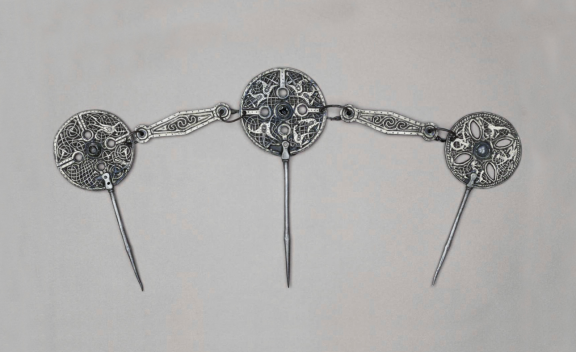
The triple pins are a set of decorative items dating back to the late 8th century in the Middle Anglo-Saxon period. Each pin consists of a disc head attached to a stem, with a composite design. The stem is separately cast and riveted to the disc through an animal head terminal on a hipped stem, creating a highly stylized appearance. The heads of the pins are gilded and intricately decorated with carvings.
The pins are interconnected by elongated rhombus-shaped links with pierced round terminals. These links are carved with spiral ornamentation and gouge markings. A wire loop connects each pin to its neighboring pins through the pierced terminals.
The central and left pins share a similar pattern, although they have slight differences in detail. They both feature a cross-shaped design with equal-shouldered arms that have widened ends. Circular "pits" are set at an angle to the pin shaft within the cross. The central part of the cross is adorned with a glass rim, and a perforated border runs along the perimeter of the cross. On the left disc, one arm contains pure lace, while the other two arms have a symmetrically interwoven floral ornament emerging from the base of a "flower pot." The fourth arm features a winged animal woven into a lace-like pattern. The three remaining arms have separate pierced details.
The middle disc is the largest of the three, and its panels are filled with winged animals with lightly carved collars and other body markings integrated into the design. The upper arms contain opposing pairs of these winged animals, while the lower arms feature a pair with an additional single animal of the same type as those in the upper arms. All the animals on the middle disc are perforated.
The right disc is noticeably different in style and appearance, suggesting that it is a substitute. It also features a cross-shaped pattern, but with extended terminals. A rope border encircles the entire disc, and there are simple borders in the ribbon-like spaces between the handles. These borders depict various creatures entangled in occasional foliate weaves, including profiles of animals and outstretched eagles. The creatures have inlaid glass eyes, and their ornamentation appears slightly pecked and frayed along the edges, contrasting with the smoother lines found on the other pins. The back of all the discs is smooth, but the last one is gilded.