



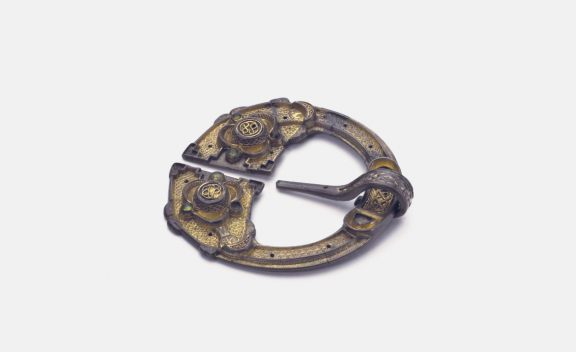
The Celtic brooch from the 8th century, attributed to the Irish culture, was found or acquired in Scotland within the British Isles. It is a silver-gilt pseudo-fingered D-shaped brooch, with the bar removed. The brooch's ring is made of solid silver and gilded on the front side, while the gilt is applied only to the decoration on the back side.
The hoop of the brooch is adorned with shaded flanges that transition into terminals, terminating with profiled bird heads. Within the scalloped borders, there are two curved panels featuring molded geometric weaves. The top part of a deep panel with scalloped semicircular settings, which is now blank, has a central gold foil applied panel framed in filigree. A simple open knot, formed by two snake-like strands of beaded gold wire, is present within this frame.
At the junction of the hoop and extended terminals, two molded profile animal heads with swirling cheeks and hatched muzzles emerge from raised sickle-shaped inset panels with beaded wire frames and collars of gold pellets. The central portion of each terminal consists of three curved segments in high relief with vertical ribbing on both facets, surrounding a tall frame with an integral cast lace collar holding a round panel of worn gold filigree. The background of the terminals is understated and textured with molded geometric weaves, divided into smaller areas by three small round frames with translucent green glass cabochons (one of which is missing). The raised edges of both terminals feature two additional bird heads, positioned back to back, and terminate in empty L-shaped cells at the top and bottom. Flat, ungilded surfaces can be observed in areas where the ring was cut.
The back of the brooch is plain, except for two raised circular inserts with applied gilded discs, each featuring three simple tubular spirals.
The pin, although incomplete, is cast with a solid loop, and a gilt silver foil with geometric weaves is riveted to the head. The hinge breaks off at the back. A decorative semicircle in low relief is present where the loop tail joins the pin. The brooch is broken in three places and has mottled holes, likely resulting from early modern repairs and possibly for connection to a base.