



Certainly, here's a rephrased version of the text you provided:
Cultural and Temporal Context: Originating from the Late Anglo-Saxon period, created in the early 11th century
Production Location: Made in Europe, in the British Isles, England
Discovery/Acquisition Location: Found in Europe, specifically in the British Isles, England, in Oxfordshire at Wallingford
Materials: Crafted from walrus ivory, with wax impressions
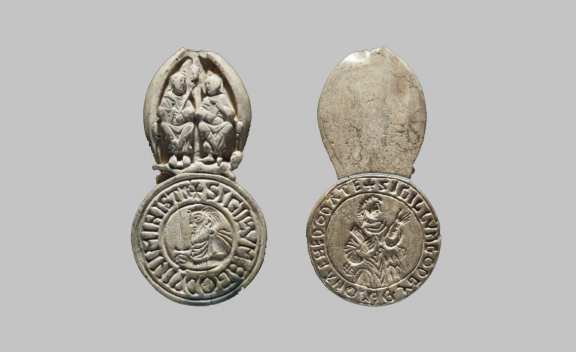
Description: This artifact is a round stamp made from walrus bone. It features engravings on both sides and includes a ribbon-shaped handle at the top. The handle itself is decorated on one side and smooth on the other, with its tip broken off.
The decorative elements on the handle side include relief images of God the Father and the Son, depicted towering over a prostrate human figure. Above them, there is a damaged representation of the Holy Spirit in the form of a dove.
On the matrix side of the stamp, there is an engraved image of a bearded man, facing left and standing in a circular frame. He holds a sword in his right hand and has a cloak clasped at the shoulder. This figure is surrounded by a carved frame, within which is a retrograde inscription.
On the reverse side of the matrix, there is a depiction of a woman seated on a cushion, facing left. Her right hand is raised, and she holds a book in her left hand. She is also encircled by a circular frame, which contains another retrograde inscription.
Additionally, there is an impression of a wax seal on this artifact.