


Certainly, here's a rephrased version of the text you provided:
Cultural and Temporal Context: Originating from the Late Anglo-Saxon period, crafted in the 10th century
Excavation/Discovery Location: Recovered from the Thames River in the British Isles, England
Materials: Crafted from iron, decorated with silver, copper alloy, and copper
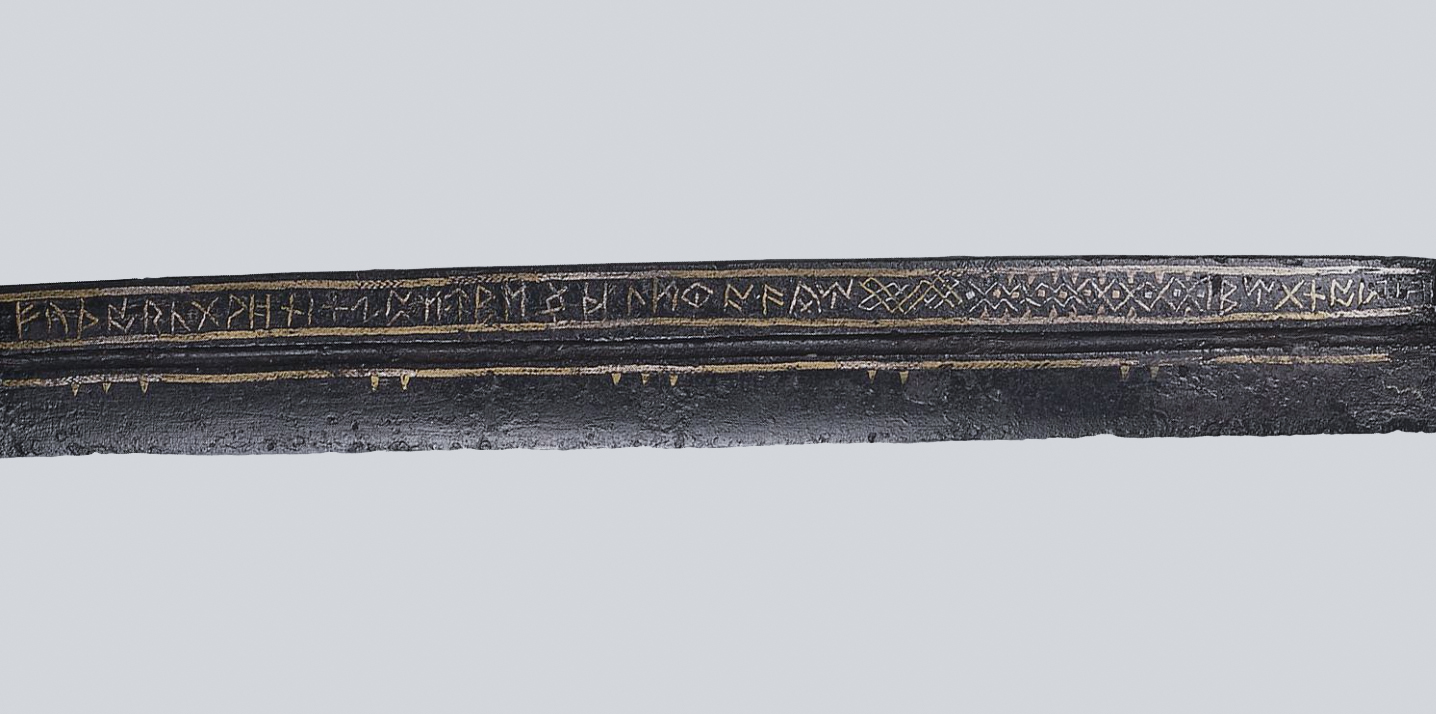
Description: This artifact is an iron seax, featuring a straight cutting edge that runs parallel to the back, which is angled toward the tip. The broad shank is offset in relation to the blade, which is adorned on both sides with linear ornaments achieved by hammering polychrome wire into the metal surface.
On each side of the blade's back, there is a narrow rectangular panel bordered by two lines composed of strips of twisted copper and brass wire. Below this panel and running parallel to it, there is a deep median groove, flanked by another inlaid line featuring suspended brass triangles.
One side of the rectangular panel bears two inscriptions. They are separated by a herringbone pattern created from silver and brass, as well as a fragment of a running lozenge pattern made from silver and copper, along with silver and brass twisted wire. Each lozenge pattern contains either a copper or silver blank. The first inscription comprises twenty-eight letters of the "futork" or runic alphabet. The second inscription, also in the runic alphabet, represents an Old English personal name, likely associated with the owner or maker of the seax.
The opposite side of the panel is filled with a running lozenge pattern, similar to the one on the obverse. However, in this case, the lozenge patterns contain only silver blanks, and the triangular fields between each lozenge pattern have a copper triangle facing inward.
The spine of the seax is inlaid with nine groups of short transverse lines made from silver and brass twisted wire. Towards the end of the panel, where it tapers to the tip, there is a vertical cut. Behind this cut, part of the decoration is missing, but a dashed dowel used for the inlay is still preserved.