



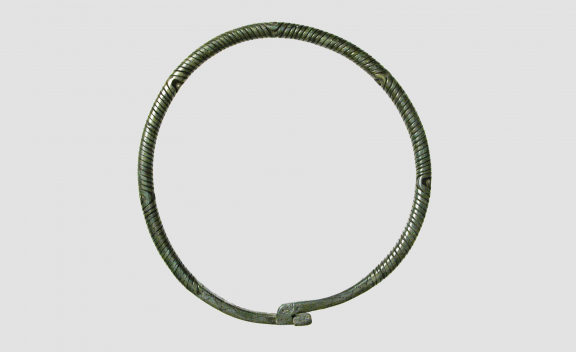
Dating back to around 600 B.C. and originating from the Scandinavian region, this torque possesses a deceptive design. At first glance, it appears to be wrapped in a wide flat wire that changes direction six times. However, this intricate pattern was not achieved through winding the wire but rather by carving it into the metal. The specific origin of this item is unknown, but similar torques have been discovered in peat bogs. It is believed that these torques were often thrown into the bogs as offerings to a god or goddess or as symbols of gratitude.
The term "torque" is derived from the Latin word "torquis" or "torques," which is related to "torqueo," meaning "to twist." This name reflects the twisted shape that many of these neck-rings have. Typically, neck-rings that open at the front when worn are referred to as "torcs," while those that open at the back are called "collars." Smaller bracelets and armlets, worn around the wrist or upper arm, sometimes share similar forms.
Torcs were crafted from single or multiple intertwined metal rods or "ropes" made of twisted wire. Most of the surviving torcs are made from materials like gold, bronze, and silver, with gold, bronze, and silver being more durable and better preserved when buried for extended periods. Elaborate examples of torcs, sometimes hollow, involved a range of crafting techniques, often beginning with casting and then further refined using various methods. The Ipswich Hoard, for instance, includes unfinished torcs that offer insight into the different stages of their production.
The flat-ended terminals of torcs are known as "buffers," and in certain types, like the "fused-buffer" shape, where what appears to be two terminals are actually a single piece, this element is referred to as a "muff." These torcs represent not only remarkable craftsmanship but also provide valuable archaeological and historical insights into the cultures of the time.