



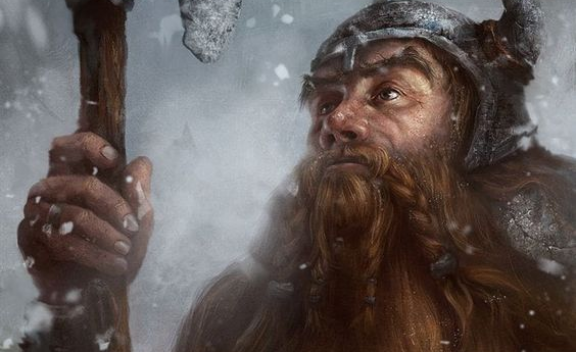
Dúrnir was a dwarf featured in three Old Norse skaldic poems, indicating that he was once a well-known character in Norse mythology.
One of the most significant poems mentioning Dúrnir is Ynglingatal:
"By Diurnir's elfin race,
Who haunt the cliffs and shun day's face,
The valiant Swegde was deceived,
The elf's false words the king believed.
The dauntless hero rushing on,
Passed through the yawning mouth of stone:
It yawned – it shut – the hero fell,
In Saekmime's hall, where giants dwell."
In a more literal translation:
"The day-fearing
offspring of Durnir
the hall's guardian
betrayed Sveigdir
who into stone
the reckless hero
ran after the dwarf.
The bright hall
of Soekmimir
built by giants
was enriched
by the chieftain's presence."
These verses describe an encounter involving Dúrnir, an elfin or dwarf character, and the hero Swegde, resulting in Swegde entering a stone structure. The poem alludes to the hero's downfall and the hall of giants, known as Saekmime's hall, which was enhanced by the presence of the hero. This tale showcases the mythical and fantastical elements often found in Norse poetry and legends.

He also appears in a list of Dwarves in the anonymous Dverga heiti:
Alþjófr, austri,
aurvangr ok dúfr,
ái, andvari,
ónn ok draupnir,
dori ok dagfinnr,
dulinn ok ónarr,
alfr ok dellingr,
óinn ok durnir.
The third poem is found in Laufás-Edda:
Kveða skal hróðr fyr hríðar
hræ-blakks viðum sævar,
drykkr var Durnis rekkum
døkkr, ljósara nøkkvi.
Snorri also includes Dúrnir in a list of giants in the Skáldskaparmál section of his Prose Edda (Faulkes translation, p. 157).
It is possible that the name Durnir is an emendation of Durinn, mentioned as the father of dvarfs in Dvergatal. Both names mean door, or door-warden. The names Durinn and Durnir do not appear in the same texts. The Norwegian translation of Ynglinga Saga from 1900 uses the name of Durinn instead of Durnir.
