



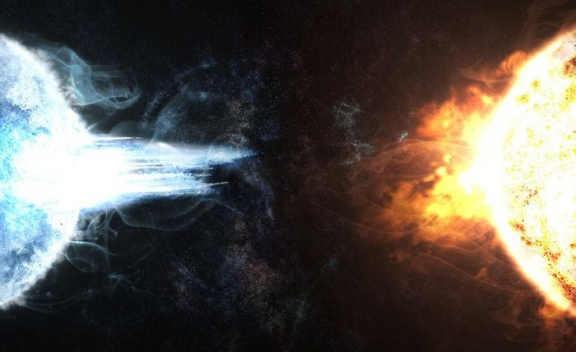
Ginnungagap is the name given to the bottomless abyss that existed before the creation of the cosmos in Norse mythology. It is also believed to be the place into which the cosmos will collapse once again during Ragnarok, the "Twilight of the Gods."
The Old Norse word "gap" has a similar meaning to its modern English counterpart, denoting a void or an empty space. However, the meaning of "ginnung" is less certain. The most widely accepted interpretation, proposed by Jan de Vries, suggests that it means "magically-charged." This interpretation implies the capacity for something to emerge from nothingness and serve as the foundation for creation.
The concept of Ginnungagap, representing perfect and uninterrupted silence and darkness, finds parallels in other mythologies around the world. For example, in Judeo-Christian mythology, the Book of Genesis describes the universe as "without form and void" before the intervention of Elohim. This theme of the contrast between the well-ordered cosmos and the lawless chaos that surrounds it is a common motif in religion and human consciousness.
In Norse mythology, the division between chaos and cosmos is expressed as the opposition between "innangard" (orderly, civilized, and law-abiding) and "utangard" (wild and anarchic). Plowed fields represent the innangard, while the wilderness beyond the fences is the utangard, the domain of giants. These anti-cosmic forces continually attempt to drag the Aesir gods, their work, and their ideals back into chaos, ultimately aiming to return the world to Ginnungagap. The abyss represents the ultimate destination where the giants seek to bring the world, a concept central to Norse cosmology and eschatology.