



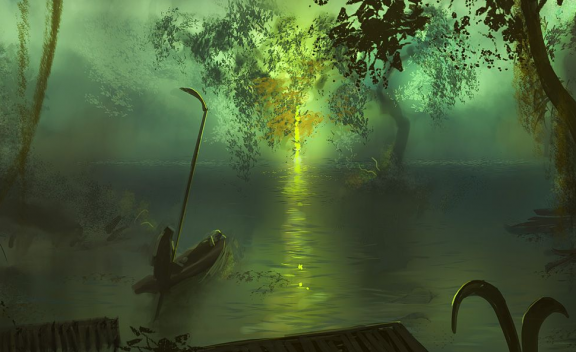
Gjöll, derived from the Old Norse "Gjǫll," is a significant river in Norse mythology that serves as the boundary between the realm of the living and the realm of the dead. It is one of the eleven rivers traditionally associated with the Élivágar, a group of rivers that existed in Ginnungagap, the primordial void, at the beginning of the world.
According to Snorri Sturluson's Gylfaginning, Gjöll originates from the wellspring Hvergelmir in Niflheim, the realm of ice and mist, and flows through Ginnungagap into the realms of existence. Gjöll is particularly noteworthy as it flows closest to the gate of the underworld, Hel. In Norse mythology, the souls of the deceased must cross the Gjallarbrú, the bridge spanning Gjöll, to reach the realm of Hel. This bridge is guarded by Móðguðr, and it was crossed by Hermóðr during his quest to retrieve Baldr from the land of the dead.
In Gylfaginning, Gjöll is one of the eleven rivers that originate from Hvergelmir. These rivers are collectively referred to as the Élivágar and are said to have flowed in Ginnungagap during primordial times.
The concept of Gjöll and its role in separating the realms of the living and the dead in Norse mythology bears a resemblance to similar mythological rivers in other Indo-European cultures, such as the Greek Styx.
Additionally, Gjöll is also associated with the boulder to which the monstrous wolf Fenrir is bound. The word "Gjöll" has been translated to mean "noisy," possibly alluding to the tumultuous nature of the river or the events surrounding it in Norse mythology.
