




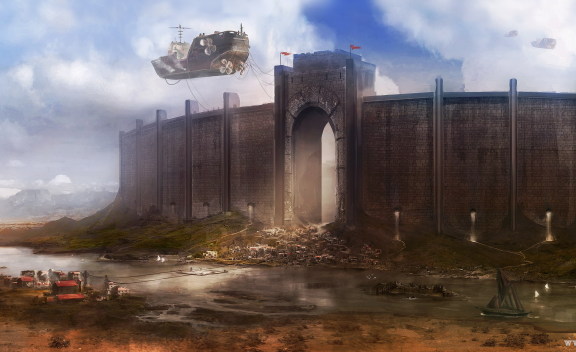
Asgard, the celestial stronghold of the Aesir tribe of gods and goddesses, is encircled by a high, protective wall. This wall (the -garðr element in the Old Norse name Ásgarðr) defends the Aesir from incursions by the giants and other beings who are often the enemies of the gods. But this wall wasn’t always there. This tale recounts how the wall was built – and this riotous story is probably one of the raunchiest and most scandalous tales in all of world mythology.
The Fortification of Asgard
A certain smith arrived at Asgard one day and offered to build the gods a high wall around their home to protect them from any who might wish them ill. The smith (certainly a giant himself) said he could complete his work in a mere three seasons, but demanded a steep compensation: the hand of the goddess Freya in marriage, as well as the sun and moon.
The gods took counsel together. Freya was adamantly against the giant’s terms from the start. But Loki suggested that the builder should obtain that which he desired, although only if he could complete his work in a single winter, with no aid from anyone but his horse. After much deliberation, the gods consented to Loki’s plan. Of course, the gods had no intention of actually giving Freya away, nor the sun or the moon; they thought that the task they demanded was impossible.
The giant smith, however, agreed to their terms, provided that the gods swear oaths to ensure that, if their conditions were met, they would fulfill their end of the bargain, and that he himself would be safe in Asgard while he worked.
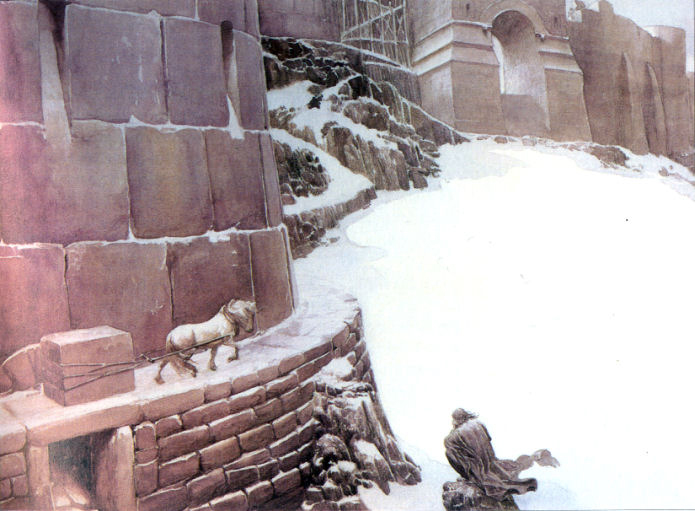
The builder set about constructing the wall, and the gods marveled at how quickly the structure was raised. What was even more perplexing to them was that the giant’s stallion, Svadilfari (“Unlucky Traveler”) seemed to be doing almost twice as much work as the smith himself, hauling enormous boulders over considerable distances to add to the edifice. When the end of winter was only three days ahead, the wall was strong enough to be impenetrable by almost any enemy, and – alarmingly – lacking little before it was finished. Only the stones around the gate had yet to be put in place.
The anxious gods seized Loki and rebuked him for giving them such foul advice. They threatened him with death if he couldn’t find a way to prevent the giant from finishing his task and making off with their beloved goddess Freya and the sun and moon, bringing neverending darkness and dreariness to the Nine Worlds. Loki pleaded with the gods to spare his life, and swore an oath that he would do as the gods desired, come what may.
Njord and his children managed to live in relative peace in Asgard. However, the situation was quite different for Hoenir and Mimir in Vanaheim. The Vanir quickly recognized that Hoenir appeared to provide exceptionally wise advice on any matter, seemingly unparalleled in his counsel. What they didn't realize, though, was that Hoenir's wisdom was only apparent when he had Mimir by his side. In truth, Hoenir was a rather slow-witted individual who found himself at a loss for words when Mimir wasn't present to guide him. When Hoenir repeatedly responded to the Vanir's pleas with the unhelpful phrase "Let others decide," the Vanir felt they had been deceived in the hostage exchange. In their frustration, they beheaded Mimir and sent his severed head back to Asgard.
Upon receiving Mimir's head, Odin, filled with grief, performed magical chants and embalmed the head with herbs to preserve it. Even in this severed state, Mimir's head continued to offer invaluable counsel to Odin in times of need.
Despite this tragic misunderstanding, both the Aesir and the Vanir remained weary of the war that had been so evenly matched. Rather than renewing hostilities, they chose a different path toward reconciliation. They came together and collectively spat into a cauldron, using their saliva to create Kvasir, who would become the wisest being of all. This creation symbolized their commitment to maintaining lasting harmony between the two tribes.
This narrative leads into the tale of the Mead of Poetry, which is another significant aspect of Norse mythology.