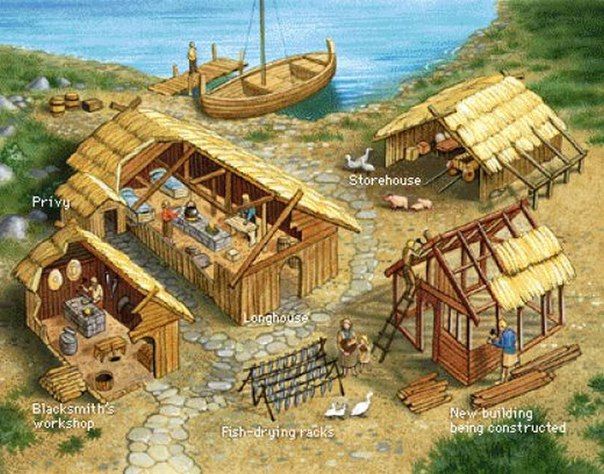


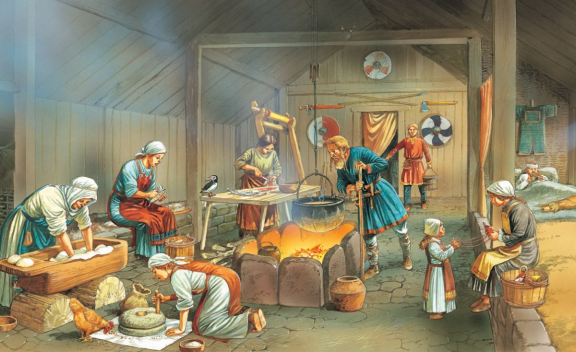
During the Viking Age, the daily lives of most men and women primarily revolved around basic farmwork to sustain their livelihoods. The majority of people resided in rural farmsteads where most of the necessities were produced locally.
Work on these farmsteads was divided along gender lines. Women typically handled tasks that were carried out "within the threshold" of the house, while men were responsible for tasks outside the house.
Women had two main responsibilities: crafting clothing and preparing food. They were skilled in baking, cooking, brewing alcoholic beverages, and producing dairy products like milk, butter, and cheese. Even activities like milking sheep and cows were considered part of their domain, although they often occurred outside the immediate household. During winter, the animals were housed within the longhouses, so they were considered within the threshold. However, in summer, when the animals grazed, shepherds, who could be male or female, watched over them.
Agricultural tasks, as opposed to food preparation, were primarily the domain of men. This encompassed activities such as fertilizing, plowing, sowing, harvesting, and threshing. During harvest, all household members typically participated due to the strenuous nature of the work, regardless of gender.
The initial step in the agricultural cycle was plowing, usually done using an ard or scratch plow during the Viking Age. This plow had an almost-vertical spike that broke up the soil without fully turning it. To compensate for this, fields were typically cross-plowed, meaning they were plowed twice with the second set of furrows intersecting perpendicularly. Ards, constructed from wood (iron plows didn't appear until after the Viking Age), needed frequent replacement, often every other day. Plowing was accomplished with the assistance of oxen or slaves, depending on availability.
Fields were maintained through crop rotation, with different fields used for planting each year to allow some to naturally regenerate. Fertilization occurred through the use of animal and human dung. During harvest, men wielded scythes for cutting while women raked the grain. Threshing the grain was the task of men, utilizing clubs and pokes. Following this, women took over, transforming the grain into bread, beer, or other food and beverages. Grain was typically ground using hand mills, though some affluent individuals started using water mills during the Viking Age.
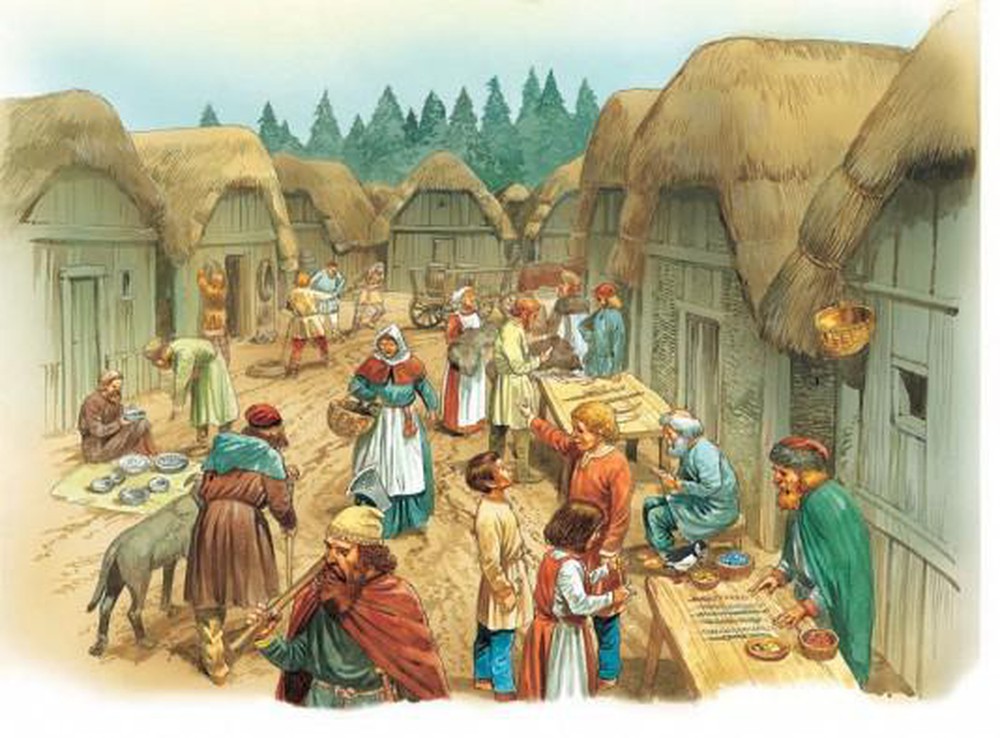
The most unpleasant and physically demanding chores – such as dunging fields, building buildings, and, as we’ve noted, pulling the plow – were typically done by slaves captured in battle or raiding.
More specialized crafts such as ironworking were often carried out on farmsteads on the limited scale necessary to meet the immediate needs of the household. Professional smiths and other craftspeople did exist in the few urban areas that punctuated the Scandinavian coastline during this period, however, and would sometimes trade their handiwork to farmers in exchange for surplus food.
While some people have a tendency to romanticize this “simpler” subsistence-centered life, the reality is that Viking Age farmwork was perilous, grueling drudgery that required incredible inputs of labor to accomplish the simplest of tasks. Famines, raids, and natural disasters were ever-present dangers that could rob the farming household of their crops and, ultimately, their lives.
Famine and disease were very common, and took their toll on the population. Something like 30-40% of children died before reaching adulthood, and skeletons from the period evidence significant disease, injury, and malnutrition. In the words of historian Anders Winroth, “The usual image of the Vikings as able-bodied, strong, and healthily virile men has an important corrective in the skeletons surviving from actual Viking Age Scandinavians.”