






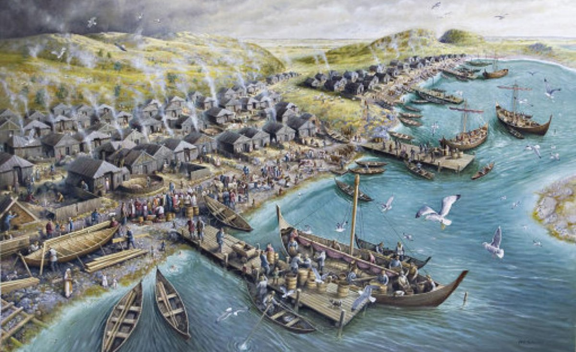
One of the most remarkable aspects of the Viking Age was the extensive trade network established by the Norse, spanning from Greenland in the west to Baghdad and central Asia in the east, connecting various peoples in between.
During the Viking Age, much like in preceding eras, the Scandinavian economy primarily revolved around subsistence farming. The majority of people lived on rural farmsteads, where each household produced most of the essentials required for their sustenance, with few indulgent items. However, even before the Viking Age, some limited domestic trade existed, mainly through seasonal rural markets.
Around the onset of the Viking Age in the eighth century, Scandinavia witnessed the emergence of its first urban centers along the Baltic Sea and the North Sea. Although only a small percentage of the population, roughly 1-2%, resided in these "trade towns," their impact on the Scandinavian economy was disproportionately significant. These trade towns played a pivotal role in integrating Scandinavia into the broader Eurasian trade networks of the time.
While most Scandinavian farmsteads manufactured their own essential goods such as clothing and tools, the rise of trade towns attracted more individuals to specialize in various crafts. Blacksmiths, jewelers, bead-makers, antler-workers, and other craftsmen flocked to these trade towns to produce goods for export to foreign markets rather than solely for subsistence or local trade.
Archaeological findings from prominent trade towns like Hedeby offer insights into the scope of Viking Age trade. These discoveries include a diverse range of traded items, such as ceramic bottles with mercury, amber, iron bars, lead, silver, foreign jewelry like carnelian and rock crystal, glassware, foreign pottery, silk, counterfeit Arab dirhams, and wine barrels from the Rhineland, which were repurposed to line well shafts. Northern products traded in Hedeby included walrus bones, reindeer antlers, Norwegian soapstone, and whetstones. While furs and textiles were also traded, they left minimal archaeological traces due to their organic nature. Notably, Hedeby was involved in the slave trade, with an iron lock from a set of slave fetters discovered in the town's harbor.
Furs, prized for their quality in the cold Scandinavian climate, and slaves constituted the two primary pillars of Viking trade. The Vikings participated in the widespread slave trade of the era, with the Arab Caliphate being a primary buyer. Slave transactions occurred in Eastern Europe and Mediterranean ports such as Venice and Marseilles. The Vikings obtained slaves primarily through raids, even raiding their fellow Scandinavians' settlements, making little distinction based on ethnicity or religion.
Trade towns themselves were not immune to Viking raids, given the valuable goods being produced and exchanged there, making them attractive targets.
The Vikings engaged in international trade primarily to acquire foreign luxury items, which served as prestigious status symbols. As a result, Viking chieftains often founded and governed these trade towns. The wealthier chieftains could afford to reward their warriors generously, leading to larger fighting forces. A bigger army enhanced a chieftain's success in raiding, further increasing his wealth and the number of warriors under his command.
Nevertheless, even simple Viking farmers sometimes possessed silver weights, indicating they had some silver for purchasing external goods for their farms. This demonstrates that trade, while primarily serving chieftains' luxury needs, had broader economic purposes. Rural inhabitants around trade towns often traded surplus items, typically food, for other goods passing through these towns.
As the year 1000 approached, bulk trade in commodities gained prominence and began to replace the earlier luxury-driven trade. Many luxury-focused trade towns vanished, leaving behind ruins and wilderness. This transformation can be attributed to a shift in Scandinavian political models, transitioning from chieftain rule over small groups to the emergence of kings ruling larger territories. The trade towns inadvertently facilitated this transition by enabling a select few chieftains to amass enough wealth and power to become kings, leading to the rise of larger urban administrative centers.