






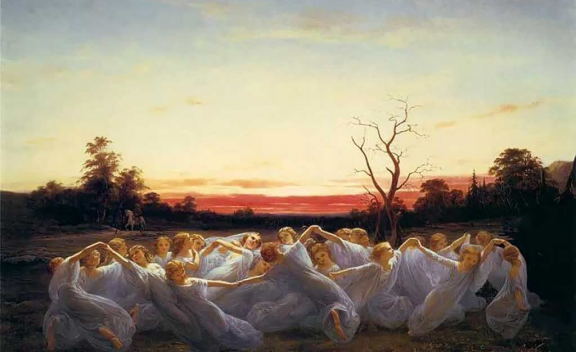
In today's world, we often perceive our surroundings as lacking enchantment and meaning. Our built environments prioritize functionality over any sense of wonder, with only occasional aesthetic embellishments. Nature, too, is appreciated primarily for its utility and occasional beauty, rather than deeper significance. Our cultural and ancestral heritage seems almost incidental to our true selves, devoid of any profound meaning. Our lives appear to lack a spiritual dimension, making it difficult to take religions seriously, even those offering salvation from our worldly concerns and entry into a realm filled with the profound meaning that our current lives lack. Many of us wonder if such meaning can truly exist anywhere, as the glimpses of enchantment we encounter are often small, pale, and cold, failing to transcend the boundaries of the mundane world in which we exist. These moments are devoid of any spiritual or religious significance, unable to address our ultimate concerns.
In contrast, the Vikings and other Germanic peoples inhabited a profoundly different world, one saturated with divine presence and sacred significance. This enchantment extended to the core aspects of their existence, where nature and Germanic culture were perceived as an interconnected whole rather than opposing forces. It's important to clarify that Germanic peoples were not "nature worshipers," as this is a modern misunderstanding of ancient paganism. Instead, they embraced what might be termed "Germanic culture-nature" as a unitary concept, accepting the world as it was and working with its inherent characteristics. This stands in contrast to the Christianity introduced to the Germanic peoples during the Viking Age and Middle Ages, which aimed to radically transform the world based on a moral vision, including changes in doctrinal beliefs.
The ancient Germanic religion exemplified what Paul Tillich, a prominent theologian and philosopher of the twentieth century, referred to as the "romantic-conservative" form of religion. In this context, "romantic" points to the experience of the infinite within the finite, as manifested in nature and history. "Conservative" emphasizes finding the ultimate within existing forms of nature and history. Those who perceive the divine in the growth of a flower, the movement of an animal, the unique individuality of a person, a specific nation, culture, or social system are described as romantic-conservative. For them, what exists is sacred and forms the core of their ultimate concerns.
Tillich contrasts this religious perspective with "moral" religiosity, where the divine resides in moral actions rather than sacramental traditions, and it is "progressive-utopian" rather than "romantic-conservative."
The Vikings and other pagan Germanic peoples did not have elements of "progressive-utopian" religiosity within their beliefs. Contrary to modern sensibilities, their deep enchantment with the world coexisted with pragmatic realism rather than idealism. They sought to advance their interests within the existing world rather than attempting to fundamentally alter its nature or "save the world," as contemporary concepts might suggest. There were no pagan Germanic "revolutionaries" as we find in modern political movements, and notions of "social justice" would likely have been met with mockery.
In their worldview, the unfolding of events was guided by an inexorable and blind fate, leaving little room for individuals to shape their destinies. They believed their agency lay in responding to their circumstances with honor and greatness or with dishonor and insignificance. From this perspective, there was no real space for "saving the world"; their focus was on making the best of their situation.
Now, let's delve into some concrete examples of the enchanted world of the Germanic peoples. In Old Norse, the word for "god" essentially meant something like "pillar" or "vital force." This suggests that the gods were seen as the "pillars" upholding the cosmos, a portrayal consistent with their depiction in myths. They weren't distant beings intervening from the outside; they were also immanent within certain parts of the world.
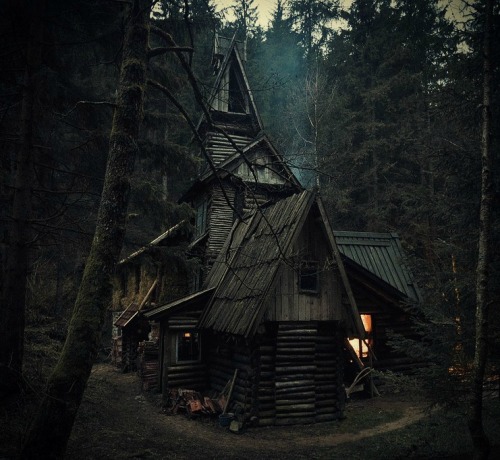

For example, Thor, whose very name meant “Thunder,” was not so much the “god of thunder” as he was the god thunder – the divinity whose presence the Vikings felt in the thunder. His wife, the goddess Sif, was known for her long, luscious, golden hair that seems to have symbolized fields of ripe grain. Sif would therefore have been the goddess grain, and the storms fertilizing the vegetation would have been practically a ritual enactment of the consummation of the marriage of Thor and Sif.
Much the same can be said of the god Forseti, the divine counterpart to the human “lawspeaker,” the head of the Norse legal assembly and judge of disputes. Just as Thor was the god thunder and Sif the goddess grain, Forseti would have been the god law – the god made manifest in the law and in the pronouncements of the lawspeaker. And so on for the other Germanic deities.
The enchanted Germanic world wasn’t only inhabited by gods, but also by lesser numinous beings such as land spirits, elves, dwarves, and giants. Any field, mountain, moor, forest, sea, stone, house, hall, person, custom, or event could potentially hold and transmit an intimation of some kind of divine presence.
Magic was a seamless part of life, and the Germanic peoples frequently had experiences whose character and outcomes they attributed to magic.
Furthermore, phenomena that we today would consider to be purely earthly could still be infused with divine power even if they weren’t inhabited by a god, a land spirit, or the like. Perhaps the most striking instance of this is the concept of heil (Old Norse heill, pronounced roughly like the modern English word “hail”). The continental Germanic word heil, from which our words “holy” and “holiness” come, originally referred to the religious status from which earthly well-being and success were thought to emanate. For example, a ruler’s heil was what made his reign prosperous, and if he failed in battle or in domestic affairs, it was due to a flaw in his heil.