



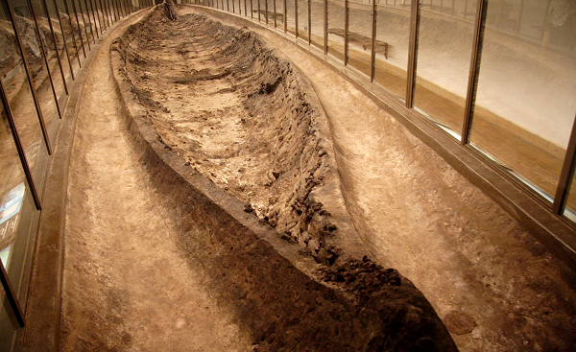
The ship Ladby belongs to a group of prominent ship burials, including the boat tomb chamber Hedeby and ship burials such as Oseberg, Borre, Gokstad, and Tune, which date back to the 9th and 10th centuries. It is the only known ship's grave found in Denmark and was discovered southwest of Kerteminde on the island of Funen.
The burial site itself is located in an unremarkable Viking Age burial ground. Numerous funerary objects, including both artifacts and animal remains, were found during the excavations. The burial was dated to the early 10th century based on a gilded bronze link for a dog harness decorated in the style of Elling.
Unfortunately, the grave had suffered significant damage. Only a few small human bones were discovered, leading researchers to conclude that the site had undergone a transformation from a pagan grave to a Christian one. Another interpretation suggests that the struggle for power between King Harald Bluetooth and his heir Svein Forkbeard may have led to the desecration of the grave. The ship, being a symbol of power visible to anyone in the area, glorified the minor king buried within. The removal of the deceased and the deliberate disassembling of the grave into hundreds of pieces within a few years after the burial dealt a significant blow to the prestige of the deceased's family.
The discovery of the Ladby ship took place on February 28, 1935, near Kerteminde in northeastern Funen, thanks to the efforts of pharmacist Paul Helveg Mikkelsen. The primary sources of information about the discovery are the original drawings made by Mikkelsen and the records of Gustav Rosenberg, the conservator at the Danish National Museum. Mikkelsen personally financed the construction of protective structures that were erected over the site, which was then covered with earth and grass. Subsequently, the ship was handed over to the National Museum, which assumed full responsibility for the site until 1994 when the Department of Archaeology and Landscape of the Viking Museum in Ladby, part of the East Funen Museums, took over.
Two significant factors related to the discovery of ships are relevant to the Ladby ship. Firstly, ship burials are often found in elevated locations such as highlands, hilltops, slopes, and coastal ridges. Secondly, ship burials are typically situated in close proximity to water, whether it be a lake, fjord, or sea. The Ladby ship aligns with these characteristics, as it is located at the top of a hill near Kerteminde Fjord. It is presumed that the ship was pulled from the fjord to the hilltop using ice slides, similar to the process employed for the Oseberg ship. The Ladby ship was a large vessel with approximately 30-32 rowers on board. While Rosenberg did not describe the shape of the mound, Mikkelsen referred to it as oval. Rosenberg had hoped to find stones arranged in a circular shape around the mound, but instead, he discovered a set of stones to the north and south of the ship and a small pile to the east. As these stones are positioned at a higher level than the row of rivets that mark the ship's planks, it is unlikely that they were used to support the ship's burial. Rosenberg concluded that the stones originated from a previous burial mound at the site, which was destroyed during the construction of the ship's grave.

During the excavation of the Ladby ship between 1935 and 1937, under Gustav Rosenberg's leadership, the ship's wood had largely disintegrated due to its age. However, approximately 2,000 rivets, which fastened the ship together, were found buried in the sand. Using the placement of these rivets as a reference, Rosenberg marked a measurement line along the ship's central axis from bow to stern. Based on this line, he estimated the ship's length to be 21.5 meters, its greatest width to be around 2.75 meters, and the depth at the midsection to be 0.65 meters. These estimates were made with the understanding that the number and location of the rivets only provide an approximation of the ship's actual size. Knud Torvildsen, who took over from Rosenberg in 1940, arrived at similar conclusions regarding the ship's dimensions.
Both Mikkelsen and Rosenberg made significant contributions to the description of the Ladby ship. Rosenberg's detailed logs from the excavation remain an essential source of information about the ship and its contents. Mikkelsen also kept a log during the excavation, although his records cover a shorter period. The records of both researchers complement each other, with Rosenberg's writing being more expert and using a colloquial language, while Mikkelsen's reflections are more emotional and focused on the excitement of discovering the ship.
There was initially some disagreement between Rosenberg and Mikkelsen regarding the iron parts found with the ship. Rosenberg doubted that they belonged to the stem, while Mikkelsen believed otherwise. Mikkelsen was relieved when Rosenberg changed his mind and concluded that the iron parts did indeed belong to the stem. These iron parts were spirally rolled-up iron ribbons, which were likely decorative ornaments placed on a wooden rod. Unfortunately, they had deteriorated and fallen apart during the excavation. The spirals were arranged in a line about 60 cm long. Both Rosenberg and Mikkelsen agreed that the stem, with its ornamentation, symbolized the mane of an animal, particularly a dragon whose head had decayed. Dragon heads were commonly carved as free "remote endings" on both large and small Viking ships. However, the specific conditions under which such decorations were allowed on ships are not entirely clear. In the 12th and 13th centuries, larger ships known as "drekar" were exclusively owned by kings. It is possible that the privilege of adorning ships with dragon heads was reserved for the king or served as a symbol of royal property. Smaller ships may have belonged to wealthy and powerful individuals, perhaps with military or administrative ties to the king, while larger ships were reserved for the king himself. The Ladby ship, with its dragon ship ornamentation, may have been used in Harald Bluetooth's campaigns.

During the excavation of the Ladby ship, Mikkelsen and Rosenberg made several interesting discoveries related to the ship's wooden structure. They found iron nails on the eastern side of the ship, spaced 25 cm apart, which formed the upper edge or "slat edge" of the boat. However, they did not find any nails on the western edge. Excavations continued near the southern stem in search of nails on the west side. Layers of wood or bark were found in this area according to Mikkelsen's observations. Rosenberg noticed that the wood strapping was only preserved where it made contact with iron, indicating that the ship's timber had largely disintegrated.
Despite the decayed state of the ship's wood, Mikkelsen and Rosenberg discovered a deposit of timber along the west side of the ship, approximately in the middle of the disturbed area. They found pieces of wood that seemed to be remnants of a larger piece, now shapeless, including a round hull-like piece protruding from a slat 27 centimeters inside the ship. Another piece of wood, or a shell of such a piece, extended from the end of the first piece toward the south, tapering to a point. There was also a thin, narrow piece of wood alongside a piece stretching from south to north, extending about 20 centimeters across to the middle of the ship.
Initially, it was difficult to determine whether these pieces of wood were from the ship and which part they belonged to. However, a few days later, Mikkelsen discovered a section of the undisturbed burial chamber that was believed to have covered the ship's contents, lying between the planks. The wood located to the west was described as "completely intact," leading Rosenberg to conclude that it derived from various layers of wood that formed the ship's structure, possibly from boards used for the deck layer. It was expected that beneath the wooden paneling, they would find the undisturbed parts of the burial chamber along with several large iron pieces protruding from the wood layer.
Further discoveries included a horizontal layer of reddish wood found at a height of 12-15 meters, likely part of a collapsed layer of boards that once formed the deck above the ship's western side. They anticipated finding the intact sections of the burial chamber beneath this decking layer. At a height of 11 to 13 meters, below the layer of wood, they discovered filaments of fibrous organic material that appeared to be unprocessed, though their precise nature could not be identified. Along the eastern part of the ship, the wood did not survive. Mikkelsen's diary also noted the absence of large pieces of wood on the eastern side of the ship.
