



The symbol known as the "Dragon Birk" has become closely associated with the famous Viking Age city of Birka, thanks to the discovery of a casting mold depicting the head of a dragon in 1887. Recent excavations at Birka's Black Earth Harbor, conducted almost 150 years later, have unveiled a clothing pin that may be directly linked to this mold. This artifact adds a unique "Birka style" to the limited collection of Viking Age pins featuring a dragon head. The authors of this research delve into the production, function, and chronology of this artifact, as well as its potential connection with the decorative ship heads.
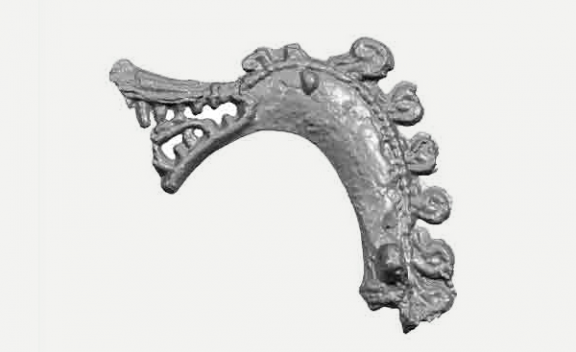
The archaeological investigations conducted in the silted harbor area in 2015 and 2016, situated in front of the settlement zone known as "Black Earth," primarily aimed to study the physical characteristics and chronological development of significant port facilities at Birka, which was a crucial long-distance trade center during the Viking Age. In close proximity to the pier, the dragon head of Birka was found, and its construction was dendrochronologically dated to 853/854 AD. When the artifact was retrieved from the wet sediments of the harbor (in the PQ 8 grid square on the L23/IV section), it was nearly entirely covered by a dense layer of soil and iron corrosion. Despite the rust covering the throat and neck, the curved form of the dragon head was still discernible, confirming its identity. Interestingly, the corrosion itself helped preserve this fragile artifact. The layers of corrosion and soil were meticulously removed in the archaeological research laboratory. Following conservation efforts, the artifact now weighs 13.5 grams, has a length of 45 mm, a maximum width of 42 mm on the face, and a neck width of 17 mm.
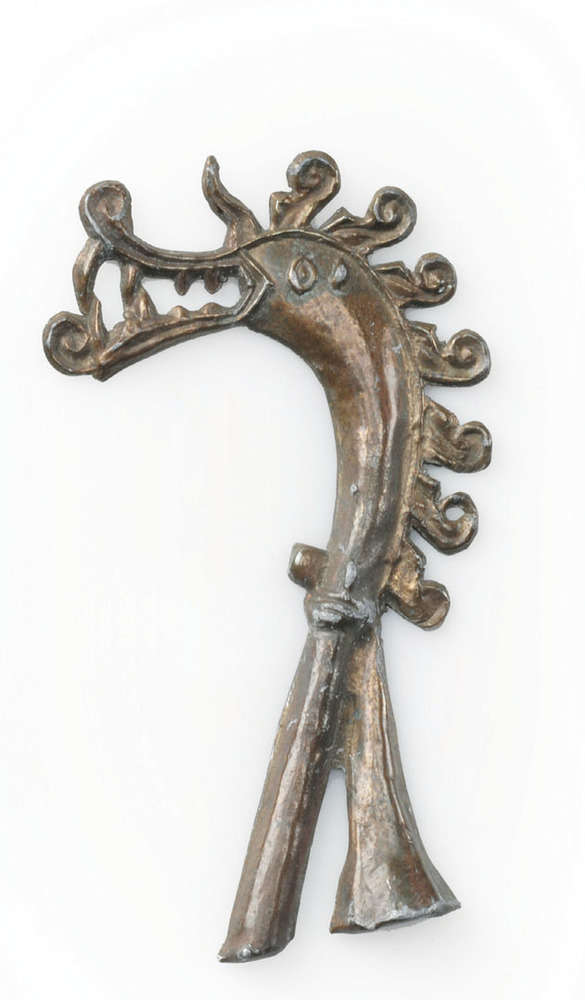
The dragon head is double-sided and features an open mouth with sharp teeth and the remnants of a coiled tongue. It also includes a beaded border around the neck, adorned with a distinctive curly mane (with five preserved curls on the neck). The eyes, curls, and pearly frame are cast in relief. Towards the lower part of the neck, there is a protruding loop (likely for a cord) and a three-sided belt terminal. At its base, there is a small round socket filled with rusty iron.
The dragon's head shows signs of damage from ancient times, including a fracture of the presumed horn and a crack just in front of it, on the upper jaw. The first curl of the mane and the tip of the tongue are missing, suggesting that the tongue was originally twisted. The artifact was cast from an alloy rich in tin, with a small amount of added lead. The "Dragon Birk" was evidently cast in a two-layer mold, as the artifact still displays casting burrs. The presence of corroded iron in the small round socket at the base of the dragon's head indicates that this decoration was once attached to an iron pin. It is highly likely that it was inserted into a specially prepared channel in a two-component mold before liquid tin was poured into the gating, ultimately resulting in the casting of the dragon head onto it.
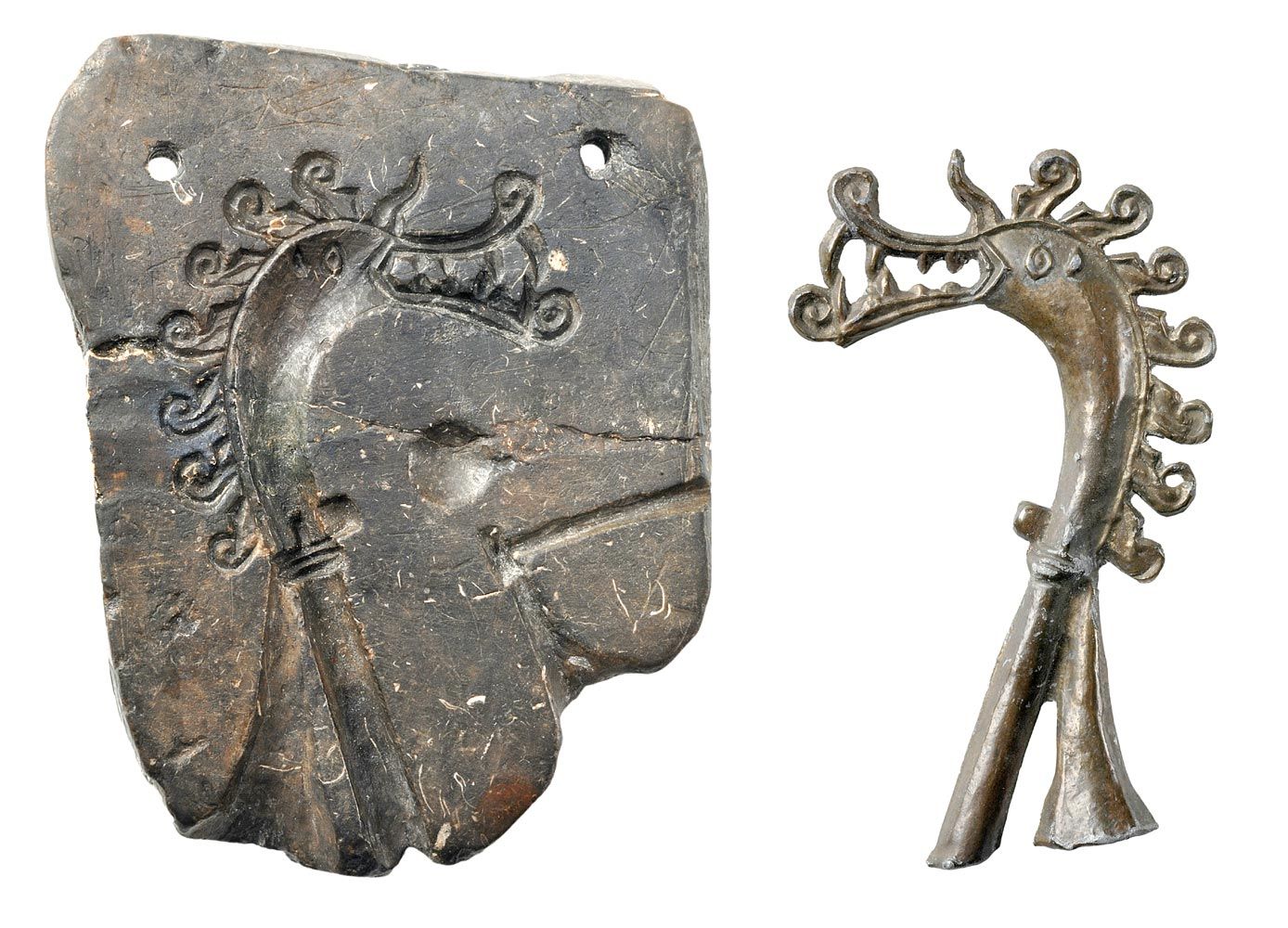
The most direct comparison to the recently discovered dragon head undoubtedly comes from Birka itself and is represented by a well-known casting mold. By 1887, half of the original two-part soapstone casting mold had been housed in the Swedish History Museum in Stockholm. According to the museum's primary inventory, this casting mold was obtained from the Birka settlement known as "Chernozemye." In the museum's catalog, the casting mold was simply described as "two halves of a broken casting mold." The Iron Age collection catalog provides a description of this artifact, accompanied by an ink drawing, stating it is "half a soapstone casting mold, broken into two parts, with one side shiny smooth and the other side rough. There is one hole drilled in each upper corner. The largest length measures 81 mm, the greatest width is 66 mm, and the thickness is 1.3 mm." This mold is currently listed in the unpublished "Sörlings Catalog," which compiles early finds from Birka, primarily originating from excavations in the Black Earth area conducted between 1871 and 1873.
The mold features a carved dragon head measuring approximately 40 × 41 mm. This dragon head exhibits a wide-open mouth with sharp teeth and a coiled tongue, as well as a pointed horn on the forehead and the characteristic curly mane on the neck. At the bottom of the neck, there is a three-sided belt terminal that connects to the protruding, forward-facing, and nearly square loop. In the lower left corner of the mold, a clear sprue can be seen leading to the lower neck of the dragon's head. Since the sprue does not connect directly to the pin's cavity, it suggests that the pin was inserted into the mold, and the dragon's head was cast on it as a composite. Additionally, it's worth noting that soapstone is a relatively soft material that tends to crack during casting. Therefore, it was likely used for casting soft metals, particularly those with low melting points, such as tin.
While the artifact is commonly described as the head of a dragon, Ambrosiani proposed an intriguing alternative theory that suggests it might represent the head of a wolf of a similar type. Such representations of animals like wolves, boars, and eagles were frequently found on shields from the Vendel period. Due to the lack of precise archaeological context for this mold, its dating is somewhat approximate, typically to the Viking period.
The image of the "dragon-like wolf's head" was so distinctive that it was chosen as the logo for "Excavations on the Black Earth 1990-1995," a project led by Ambrosiani, and it was subsequently adopted as an emblem for the Birka Studies series. Today, the cult of the "Birka Dragon" has become synonymous with the World Heritage Site itself.
Nearly 130 years after the discovery of the mold, a cast replica of it was finally recovered from Chernozem in Birka Harbor. However, unlike the recently discovered dragon head, the image on this mold depicts seven curls, which indicates that it cannot be the actual mold from which the dragon head was cast.