

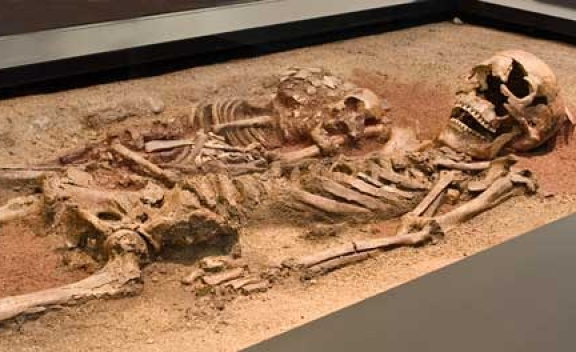
In the late 1980s, an archaeological excavation took place at Gøngehusvej 7 in Vedbæk. This site revealed a fascinating glimpse into the past, with findings dating back to around 5000 B.C. The excavation uncovered various features, including pits and graves containing the remains of both infants and adults, who were either buried or cremated. Among the discoveries were notable items like a dog burial and a well-preserved double grave.
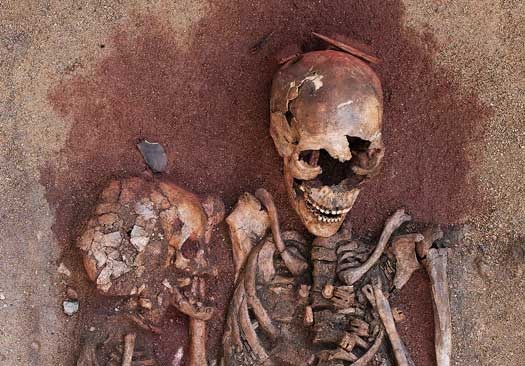
The double grave was particularly intriguing, containing the remains of a woman in her 40s and a 3-year-old child. Both skeletons were adorned with red ochre, and they were buried with beads and amulets made from the bones of red and roe deer, wild boar, elk, bear, and bison.
Notably, the woman in the Gøngehusvej grave bore a significant injury to the back of her head, which suggests a traumatic event in her life. Her head featured a bone stud and the remains of a bird's beak, hinting at the possibility that she once wore a birdskin hat, of which only the bill remained. Two bone-weaving needles and hoof bones from a roe deer were found on her chest, and the bones were wrapped in leather around her body. Meanwhile, the child in the same grave was interred with two flint knives, indicating that it may have been a boy.
During the Mesolithic period, various burial practices were employed. At Gøngehusvej in Vedbæk, both inhumation (traditional burial) and cremation were practiced, and graves ranged from single to double burials. The site also contained graves for children and even a burial for a dog.
One of the graves held a newborn baby buried on a wooden plate, surrounded by traces of ochre. This grave was left open, possibly allowing for the baby to be observed. Death was an integral part of life in the Stone Age, which might explain why Stone Age burials are sometimes found within settlements. Notably, not everyone received a formal burial, as evidenced by scattered human bone finds in Mesolithic dumps.
The head injury sustained by the Gøngehusvej woman indicated that she had been struck with a blunt object. Remarkably, she survived the blow, as evidenced by the healing of the wound. However, such a severe impact could have resulted in some degree of brain damage, potentially leading to reduced hearing or vision. The reason behind the head injury remains a mystery, but her head featured a significant bone stud and a beak, which might have once been part of a birdskin hat. This headdress could have concealed the scar at the base of her head, adding an intriguing layer to her story.