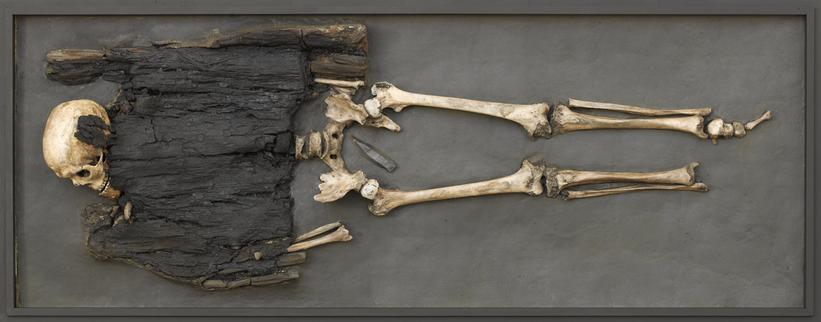


The discovery of human remains in Corser Harbor, including a remarkably well-preserved underwater grave, provides valuable insights into the past, specifically the Ertebølle culture. This submerged burial site contained the body of an adult male, buried during the Ertebølle culture period. The grave included a stretcher made of twigs and a layer of bark that had been wrapped around the body prior to burial. Unfortunately, much of the bark layer was damaged when the grave was discovered. Adjacent to the body, a flint knife was found near the waist area. Additionally, the man's skull displayed scars indicative of a severe blow, suggesting he had survived a violent encounter. The fate of his opponent remains unknown.
To determine the age of organic materials such as plants, animals, or human remains, the carbon-14 dating method is often employed. Carbon-14 is a radioactive isotope that exists in the Earth's biological cycle. All living organisms absorb carbon-14 during their lifetimes. Carbon-14 is radioactive and gradually decays over time, becoming progressively smaller. When an organism dies, it ceases to absorb carbon-14. By measuring the remaining amount of carbon-14 in an organism, scientists can estimate its age, though this measurement typically comes with a margin of error, denoted as +/-.
Over time, significant geological shifts have occurred in Denmark, resulting in a tilt of the land by about 15 meters. Settlements that were once situated along the coast, such as those at Tversted south of Skagen, are now positioned 12 meters above sea level. Conversely, in the southern regions of Denmark, such as around the island of Erö, settlements now lie up to 3 meters below the water's surface. In Zealand, settlements and graves have been elevated by 4-5 meters in the northeast (e.g., Vedbæk) but have sunk by 1-2 meters in the southwest (e.g., Korsør Nor). This geological phenomenon explains why the man from Korsør Nor was found underwater, despite having originally been buried on dry land. Similarly, the remains of other individuals have been disrupted and scattered on the seabed over millennia due to the shifting sea levels and geological movements.
Skeletons from the Stone Age frequently exhibit signs of violence. For instance, a man from Bögebakken in Wedbeck was killed by a precise arrow shot to the neck, which was still lodged in his throat when he was buried 7,000 years ago. Evidence of violence can be observed on other Stone Age skeletons as well. The man from Korsør-Nor sustained one or more blows to the head, from which he survived. These indications of violence and possible murder may be linked to territorial disputes that arose due to increased population density toward the end of the Mesolithic period. Such conflicts and struggles for territory could have been a consequence of the changing dynamics of the time.