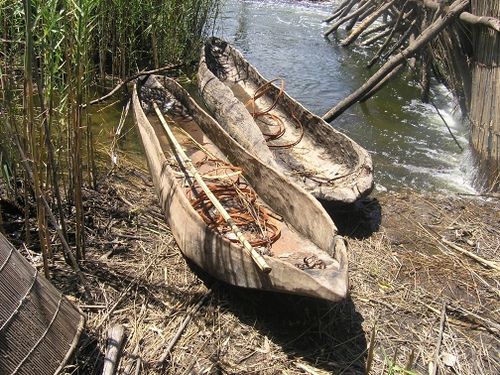


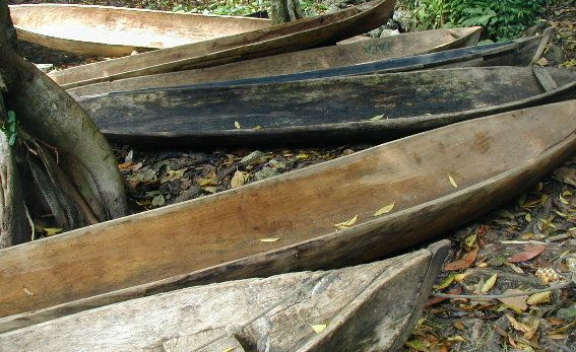
In the Stone Age, water served as the most accessible means of transportation, given the extensive forests and swamps that covered the land, making overland travel difficult. Consequently, boats became one of the most crucial tools for Stone Age people. While we primarily know of canoes made from hollowed tree trunks, referred to as "dugout boats," it's possible that these vessels were also constructed from other materials such as bark and leather. These boats, whether used on land or water, were employed for sailing, fishing, and, interestingly, as coffins for the deceased on their final journey.
During the Stone Age, boats were crafted primarily from linden wood. As the Neolithic period dawned, alder, linden, and oak also became materials used for creating dugout boats. One notable example is the dugout boat from Broxe in Holmegard's Mose, South Zealand, dating back to around 3500 B.C. This oak trunk kayak measures 3.8 meters in length and 0.55 meters in width at the stern. It was painstakingly carved using axes and wedges. At the stern, there's a row of holes for affixing a wooden plate known as a "bulkhead."
Archaeological evidence of dugout boats has been uncovered in marshy regions where wood preservation was possible. Many Stone Age boats have been discovered by divers in underwater settlements or found during peat excavation in inland marshes. Over time, boat remains tend to become soft and distorted after prolonged exposure to the seabed or swamp conditions. In some cases, remnants of wood chopping and splitting for dugout boats have also been found.
Mesolithic dugout boats were typically constructed from linden wood, which was easy to work with using flint axes and resistant to splitting. The boat's sides were made to be 1-2 centimeters thick, while the bottom was approximately 3-5 centimeters thick. The bow was pointed, and the stern was cut straight, ending with a semi-circular bulkhead. This bulkhead, a loose plate, was fastened to the inner side of the boat using stakes. This construction method allowed for the creation of a lightweight and flexible vessel, weighing between 250-350 kilograms, capable of carrying six to eight people at a time. In the event of damage, such as splitting or cracking, dugout boats could be repaired by stitching or patching the affected area with resin or clay, making them more practical to maintain than replacing them entirely.
Propulsion of these boats typically relied on oars or wooden poles. Some paddles had long poles with oval or rounded blades, while others were shorter with wide, heart-shaped blades. The choice of paddle likely depended on whether they were used for maneuvering the boat in open seas or shallow waters. The blade shape may also have been tailored to suit the user's needs.
Towards the latter part of the Mesolithic period, dugout boats began to serve another purpose—as coffins or burial covers. At the underwater settlement of Møllegabet, near Erösköbing in the archipelago south of Funen, archaeologists discovered a 2.5-meter-long section of a dugout boat near the water's edge, not far from the settlement. In and around this boat lay the remains of a young man of about 25 years. His skull displayed signs of healed injuries, suggesting he had survived past trauma. Evidently, the deceased individual had been placed in the boat, covered with a layer of bark, and then buried underwater near the settlement.