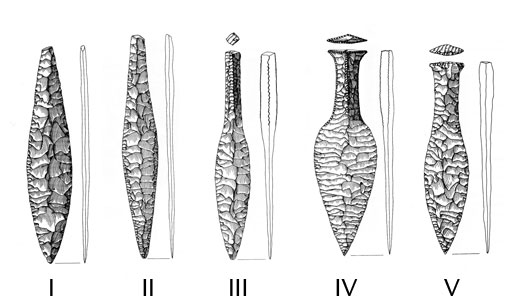


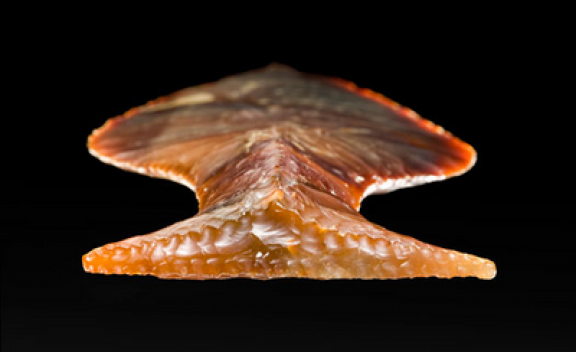
The Neolithic period marked a significant advancement in flint craftsmanship, with flint artisans achieving remarkable technical standards. A prominent example of this exceptional flint craftsmanship from the end of the Stone Age is the magnificent dagger from Hindsgavl. This dagger featured a blade with a thickness of less than 1 cm and is regarded as one of the finest expressions of late Stone Age flint craftsmanship. It was discovered around 1876 on Fenyo Island in the Little Belt region. This particular type of dagger earned the moniker "fishtail dagger" due to the shape of its handle. Daggers featuring pressure bars like this marked the onset of the late Stone Age, giving rise to the term "dagger period" for the period spanning from 2400 to 1800 B.C.
Crafting a flint dagger of the caliber of the Hindsgavl dagger was not a skill possessed by everyone. It was a highly specialized craft that demanded a masterful level of expertise, surpassing anything seen before in flint craftsmanship. The key to creating sophisticated daggers lay in the use of what is known as the "soft technique." This involved striking the flint directly with a soft hammer crafted from horn or hard wood, allowing for the initial rough shaping of the flint object. Subsequently, a small tool could be pressed against the dagger's surface to carefully remove small, elongated flint flakes, refining the final shape.
Flint daggers made their appearance towards the conclusion of the Neolithic period, coinciding with the onset of the Early Bronze Age on the European continent. These daggers became a significant symbol of social status. In Denmark, flint daggers were produced, following the design principles of European metal daggers. The exceptional skills of flint craftsmen allowed them to craft elegant daggers with thin blades. Their technical prowess reached its zenith at the end of the dagger period, exemplified by the Hindsgavl dagger. During this period, flint craftsmen faced stiff competition from imported metal daggers. This marked the culmination of the heyday of flint craftsmanship.
While bronze gained widespread popularity, the production of exquisite flint daggers continued, even into the Bronze Age. This demonstrates the enduring appeal and quality of flint craftsmanship, even as metalworking became the dominant technology for weaponry and tools.
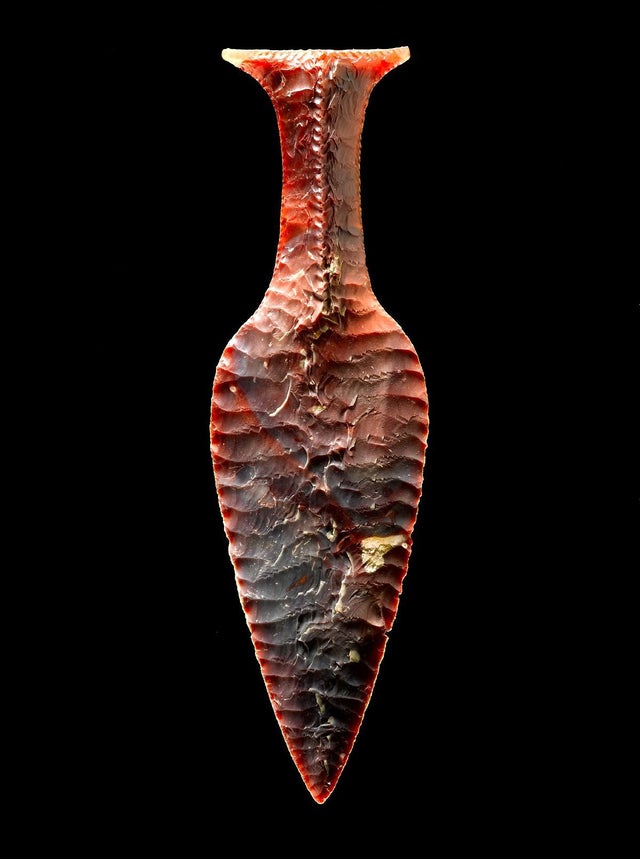
Crafted flint daggers held significant appeal among the farming communities of Denmark at the conclusion of the third millennium BC. They were utilized throughout the country, but their primary production centers were located in northern Jutland and southeastern Denmark. While many flint tools from the Stone Age, such as axes and knives, served practical purposes in daily life, daggers appeared to have had a distinct role. They functioned as objects of prestige, showcasing the status of their owners. In the graves of men from the dagger era, these daggers were often found placed on the body's belt, underscoring their symbolic and social importance.
During the Dagger Age, which marked the end of the Neolithic period, splendid flint daggers gained popularity. Although flint craftsmen adhered to traditional methods and were deeply rooted in their craft, they were also receptive to evolving fashion trends. As a result, the appearance of flint daggers evolved over time. Archaeologists have identified six distinct types of daggers based mainly on variations in their hilts. These typological differences allow archaeologists to relatively narrow down the dating of these daggers. These types primarily differentiate based on the hilt design. The Hindsgavl dagger, for example, falls into the category of type IV daggers, distinguished by specific hilt characteristics.