




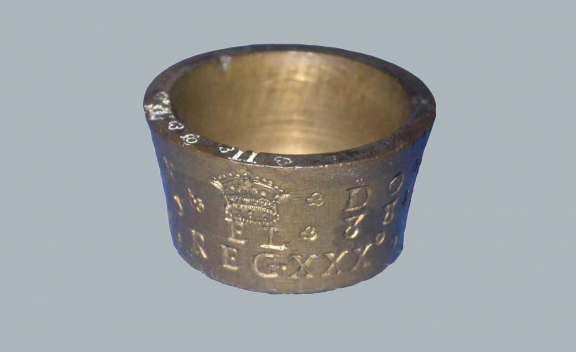
The City of Winchester is fortunate to possess the oldest surviving set of standard weights, the most ancient standard yard measure, and a valuable collection of other ancient measurement tools. These standard weights and measures were employed for quantifying the merchandise sold, as well as for the weights and measures employed by merchants to assess their wares. This facilitated both government taxation and equitable commerce.
Winchester Measurement:
To trace the origins of the term "Winchester measurement," we must journey back to the Anglo-Saxon era when, during the reign of Alfred the Great (A.D. 871 - 899), Winchester began to assume an increasingly significant role in the kingdom's administration and as a hub of trade. During the subsequent rule of Edgar the Peaceful (A.D. 959-975), it was decreed that all measurements should adhere to the standards maintained in Winchester and London. Consequently, the bushel and its subdivisions - pecks, gallons, quarts, and pints - came to be known as the "Winchester measurement" and were employed for measuring all grains and agricultural products until they were replaced by the imperial measurement (approximately 3% larger) in 1824. Nevertheless, the traditional Winchester bushel is still used in the United States.
Troy Weight:
The Troy weight is the earliest known English commercial weight, believed to derive its name from the French city of Troyes, a crucial trading center during the early Middle Ages. Under this system, 1 troy pound equates to 12 ounces, 240 pennyweights (dwt), or 5,760 troy grains; traditionally, a troy grain corresponds to the weight of a grain of barley. The earliest weights were based on seeds, thus giving rise to the continued use of the terms "grain" and "carat" today, with "grain" originating from wheat grains and "carat" from carob plant seeds. Troy weights are now exclusively employed for precious metals and gemstones.
Avoirdupois Weight:
The Avoirdupois weight evolved gradually from the Troy weight during the late 13th and early 14th centuries. The term comes from the Old French "avoir de pois," signifying "goods of weight," and evolved from the concept that quantity of goods, rather than weight, was the focus of trade. Under the Avoirdupois system, 1 pound is equivalent to 16 ounces or 7,000 grains, and 14 pounds constitute 1 stone. When referring to the imperial system, it is the Avoirdupois system that is meant.
Weight of Wool:
As previously mentioned, Winchester weights and measures serve as standards for verifying the conformity of traded goods, and during medieval England, one of the most crucial trade commodities was wool. By 1421, customs duties from wool alone contributed to 74 percent of all customs revenue in England. Just like the fluctuating value of the pound sterling, the size of the stone also varied. However, in 1340, during the reign of Edward III, the stone was standardized at 14 pounds sterling. This may have been done to align with the measurements used in some continental European trading centers, such as Flanders, to facilitate trade. This change possibly played a role in making the Avoirdupois system more appealing than the Troy system. Edward III decreed that a bag of wool, defined as 2 weights, should be 26 stones or 364 pounds.