



Cultural Background/Time Period: Viking
Creation Date: 10th to 11th Century
Origin/Discovery Location: Europe, specifically in the British Isles, England, in North Yorkshire, York
Materials Used: Deer antler
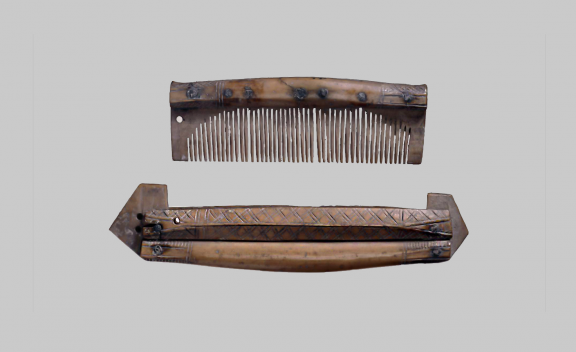
Description: This artifact is crafted from a deer antler and comprises several components. The main body of the artifact features a lattice pattern with pointed ends. At one end of the antler, there are two holes.
The artifact is constructed from two outer back plates and two inner plates, which are separated by two end plates and fastened together using four iron rivets. The outer plates have a flat convex shape with a convex outer edge that is flattened at both ends. The ends are decorated similarly to a comb back, but instead of transverse shading, they feature rows of transverse lines within the margins.
The inner plates have a triangular section, are flattened at the ends, and are adorned with two rows of irregular diagonal crosses made of double lines. The flattened triangular fields at both ends are relatively simple in design, and the transition to the central zone is marked by a pair of cross lines.
The end plates serve as spacers, keeping the plates apart and allowing for a ridge to be set between them. These end plates have a smooth surface with triangular ends, and the upper part of them includes a pair of circular holes, likely used for hanging or attachment purposes. This artifact provides insight into the craftsmanship and artistic style of the Viking period in the 10th to 11th centuries.