



School/Style: Urnes style
Cultural Background/Time Period: Late Viking Period (Viking), Late Anglo-Saxon
Creation Date: Late 11th Century
Origin/Discovery Location: Europe, British Isles, England, Somerset (Pitney)
Materials Used: Copper alloy, Gold
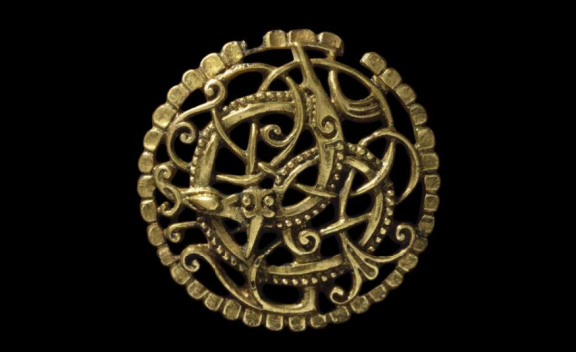
Description: This exquisite brooch exemplifies the Urnes style and is made of copper alloy with gilding. The circular brooch features a convex surface bordered by a serrated edge. Within this border is a captivating openwork design depicting a ribbon-curled animal engaged in combat with a snake.
The animal portrayed on the brooch has distinct features, including a ribbon-shaped eye and an S-shaped projection on its upper jaw. Another projection extends from the neck of the creature. The animal is depicted in the act of biting its own body, which is composed of both simple and beaded bands, forming a heart-shaped loop. The creature's hips are spiral-shaped, and its front paw is sharply curved, ending in a three-toed foot. The hind paw divides into two antennae, with the longer one intertwining with the body and terminating in a leaf-shaped trefoil.
The snake, on the other hand, has a head with two prominent eyes and appears to bisect the animal's neck when viewed from above. Its slender body, adorned with a single tendril branch, is intertwined with the animal's body and culminates in two twisted tendrils.
The reverse side of the brooch is also gilded and retains remnants of a loop and a latch that once held a pin, which is now lost. This remarkable brooch exemplifies the intricate craftsmanship and artistic expression of the Urnes style during the late 11th century, blending elements from both the Viking and Late Anglo-Saxon periods.