



Similar to the Faroe Islands, legends suggest that a few Irish monks may have inhabited Iceland prior to the Vikings' arrival. This notion is plausible, especially since it appears that the Norse were aware of Iceland's existence before their initial expedition there. If these Irish monks did indeed precede the Norse settlers, they likely departed shortly after the Norse arrived, likely to preserve their secluded way of life, particularly in the face of interaction with pagan newcomers.
The first Viking expedition to Iceland occurred around 860 and was primarily exploratory; no one stayed to establish a settlement. The island received its name from one of the expedition members, Floki (Flóki Vilgerðarson), who was disheartened by the harshness of the winter.
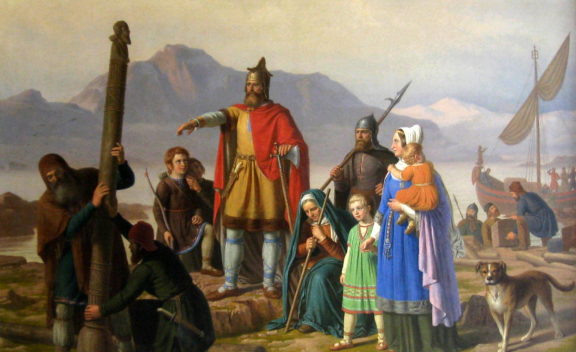
The Norse colonization of Iceland began approximately in 870. Roughly half of the settlers hailed from the region around Bergen, Norway, driven primarily by a desire to escape the oppressive rule of King Harald Fairhair. The other half came from various parts of Scandinavia and the British Isles. By 920 or 930, all the arable land had been settled, and Iceland boasted tens of thousands of inhabitants by the mid-tenth century.
The original population of Iceland appears to have had a significant Celtic influence, suggesting that a number of Celts likely accompanied the Vikings in roles such as spouses, slaves, or in other capacities. Among the original settlers, there were Christians, and over time, the proportion of Christians relative to pagans increased. The official conversion to Christianity around the year 1000 marked a significant turning point in this transition.
Although Iceland remained an independent state for several centuries, Norway wielded substantial cultural and political influence over it, largely due to the significant number of Norwegians among the early settlers. In the mid-thirteenth century, well after the conclusion of the Viking Age, Iceland formally submitted to Norwegian rule.