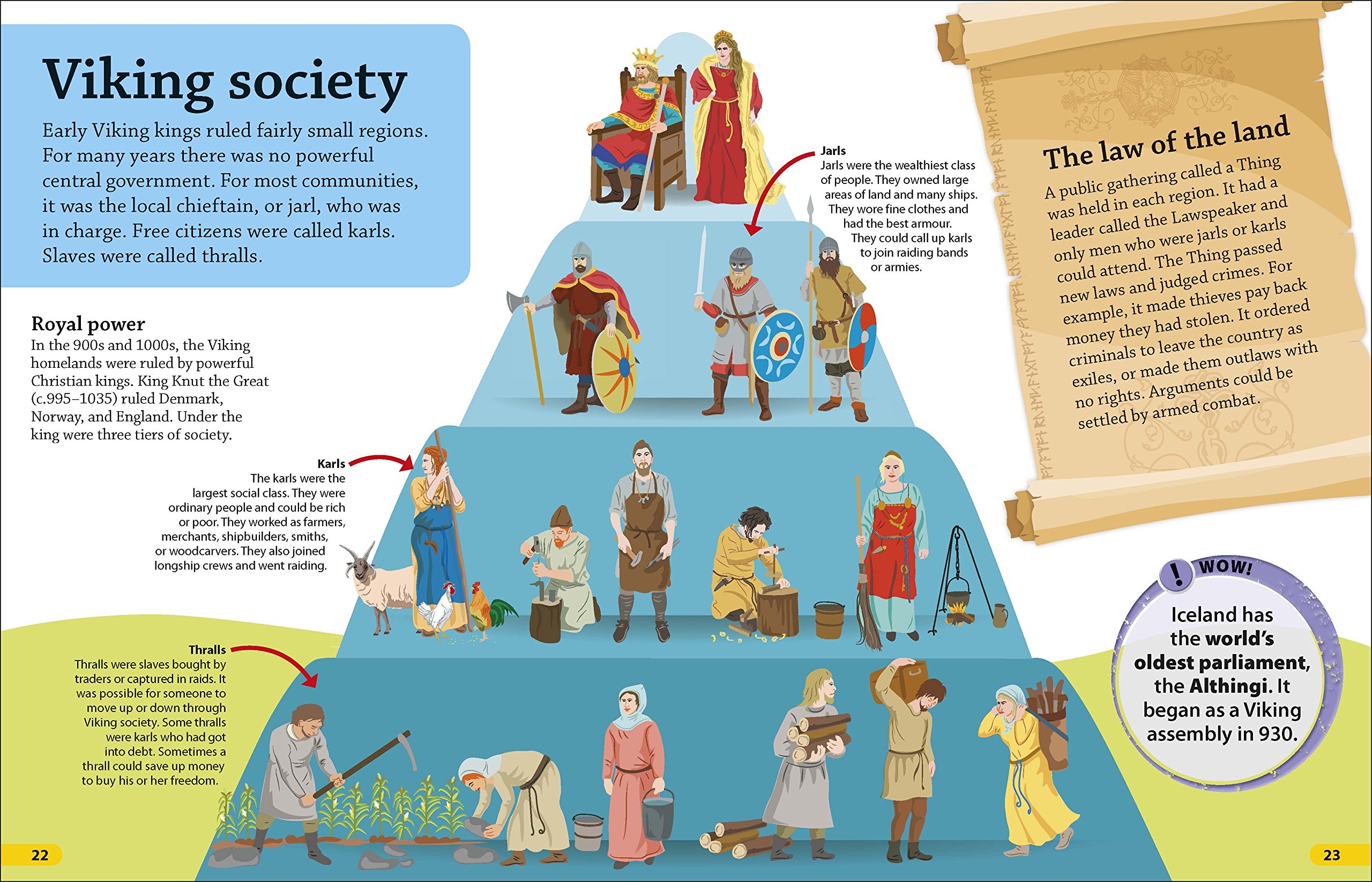


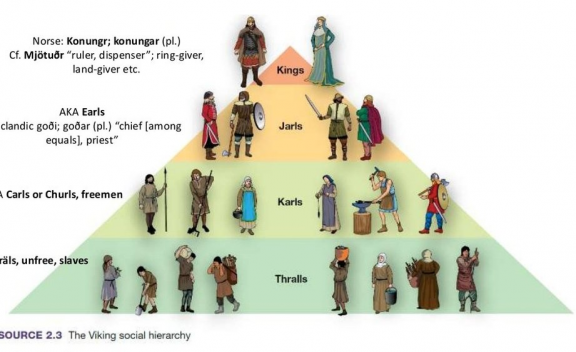
The Viking social structure consisted of three primary social classes: earls, free individuals (including both men and women), and slaves.
At the highest level of the social hierarchy were the earls (known as "jarlar" in Old Norse, with "jarl" being the singular form). Traditionally, during much of the Viking Age, earls were chieftains and warlords who had amassed significant wealth and a loyal following through their success in battles and raids. As the Viking Age progressed and kings began to rise in power in Scandinavia, earls evolved into aristocrats who were subservient to the kings and managed land on their behalf.
The second social class encompassed the majority of Viking society: free individuals (referred to as "karlar" in Old Norse, with "karl" being the singular form). Most free individuals were engaged in farming, either as land-owning farmers or as laborers working for wealthier landowners. Some free individuals pursued careers as craftsmen, merchants, or soldiers. Unlike slaves, free individuals had legal rights and protections under the law.
Viking warriors primarily belonged to the class of free individuals. Typically, they were young men with limited wealth who embarked on raids to acquire land or portable wealth, such as silver. They were often unmarried and unburdened by familial responsibilities, making them more mobile and driven to improve their circumstances. Inheritance customs favored older sons, leading many Viking raiders to be younger sons with limited inheritances. These ambitious young men sought to enhance their prospects, and their status as free individuals allowed them to do so.
Slaves (known as "þrælar" in Old Norse, with "þræll" being the singular form) occupied the lowest rung of Viking society. They were primarily used for agricultural labor and were sometimes sold, either within their home region or in the thriving slave trade that spanned Europe and Asia during the era. In some instances, when a slave's owner passed away, the slave might be sacrificed and buried alongside the owner, possibly to serve them in the afterlife.
There were three main ways to become a slave during the Viking Age. First, one could be born to slave parents, as the offspring of slaves were also considered slaves. Second, individuals could be captured in warfare, and those whose lives were spared were seen as receiving a significant gift—their life—which they were expected to repay with their freedom. This concept of reciprocity was a primary rationale for slavery. The third path to slavery involved financial hardship, where an extremely impoverished but free person could surrender their freedom to a more affluent individual in exchange for material support. This was particularly common when individuals fell into destitution due to debts, as their freedom was the only asset they could offer their creditors.