



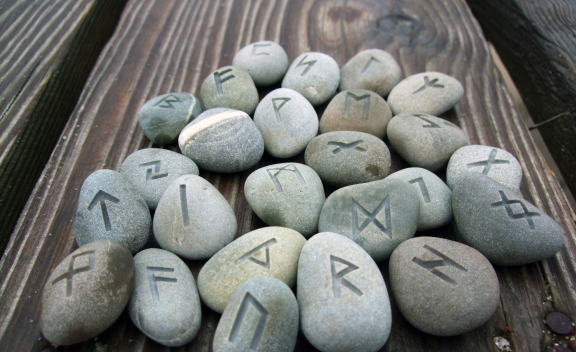
The runic alphabets used by the Norse and other Germanic peoples were the earliest systems of writing in these cultures. Runes were not merely letters; they held deeper significance and were associated with cosmological principles and mystical forces. In Germanic languages, the word "rune" itself carries a dual meaning, signifying both "letter" and "secret" or "mystery." Originally, it might have meant a hushed or secret message.
Each rune had a name that reflected its philosophical and magical importance, often tied to the sound represented by the rune's name, typically the initial sound. For instance, the T-rune, called *Tiwaz in Proto-Germanic, was named after the god Tiwaz (known as Tyr in the Viking Age). Tiwaz was associated with the daytime sky, and the visual form of the T-rune resembled an upward-pointing arrow, alluding to the god's role in warfare. The T-rune was often used as a standalone ideograph, not as part of a word, in spells aimed at ensuring victory in battle.
These runic alphabets were much more than tools for writing; they were instruments for invoking and directing cosmic forces, making them essential elements of both writing and magic in the Norse and Germanic cultures.
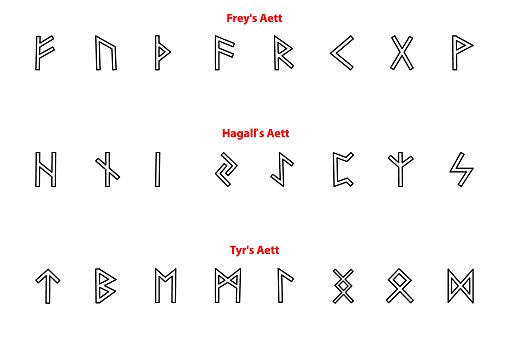
The runic alphabets are called “futharks” after the first six runes (Fehu, Uruz, Thurisaz, Ansuz, Raidho, Kaunan), in much the same way that the word “alphabet” comes from the names of the first two Semitic letters (Aleph, Beth). There are three principal futharks: the 24-character Elder Futhark, the first fully-formed runic alphabet, whose development had begun by the first century CE and had been completed before the year 400; the 16-character Younger Futhark, which began to diverge from the Elder Futhark around the beginning of the Viking Age (c. 750 CE) and eventually replaced that older alphabet in Scandinavia; and the 33-character Anglo-Saxon Futhorc, which gradually altered and added to the Elder Futhark in England. On some inscriptions, the twenty-four runes of the Elder Futhark were divided into three ættir (Old Norse, “families”) of eight runes each, but the significance of this division is unfortunately unknown.
Runes were traditionally carved onto stone, wood, bone, metal, or some similarly hard surface rather than drawn with ink and pen on parchment. This explains their sharp, angular form, which was well-suited to the medium.
Much of our current knowledge of the meanings the ancient Germanic peoples attributed to the runes comes from the three “Rune Poems,” documents from Iceland, Norway, and England that provide a short stanza about each rune in their respective futharks (the Younger Futhark is treated in the Icelandic and Norwegian Rune Poems, while the Anglo-Saxon Futhorc is discussed in the Old English Rune Poem).