



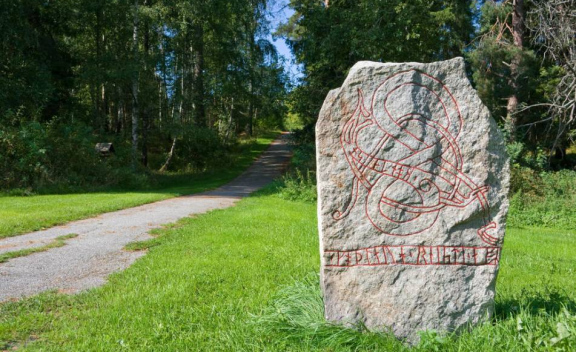
The historical origins of runic writing are a subject of scholarly debate, but there is a general consensus on a likely outline of their development. Runes are believed to have been derived from one of the Old Italic alphabets used by Mediterranean peoples in the first century CE, who lived to the south of Germanic tribes. It's also possible that earlier Germanic symbols, found in northern European rock carvings, played a role in shaping the runic script.
The earliest possibly runic inscription is on the Meldorf brooch, created in northern Germany around 50 CE. However, this inscription is somewhat ambiguous, and there is debate among scholars about whether the letters are runic or Roman. The earliest unambiguous runic inscriptions date to around 160 CE and are found on the Vimose comb in Denmark and the Øvre Stabu spearhead in southern Norway. The earliest known carving of the entire runic alphabet in order is found on the Kylver stone from Gotland, Sweden, dating to approximately 400 CE.
The transmission of writing from southern Europe to northern Europe likely occurred through interactions with Germanic warbands, the dominant military institution in northern Europe during that period. These warbands would have encountered Italic writing during campaigns among their southern neighbors. The association of runes with the god Odin is significant in this context, as Odin was already the dominant deity in the pantheons of many Germanic tribes by the first century CE, according to the Roman historian Tacitus. Whether the runes and the cult of Odin developed together or whether one predates the other is a matter of debate.
According to Norse mythology, Odin is associated with the discovery of the runes through a personal ordeal. In the poem "Hávamál," Odin describes hanging on a wind-blasted tree for nine nights, pierced by his own spear and sacrificing himself to himself. During this ordeal, he peered down and took up the runes, screaming as he grasped them, before falling back. This mythic tale reinforces the idea that the runes are not a human invention but rather eternal, pre-existent forces that Odin unlocked through his sacrifice.


The tree from which Odin hangs himself is surely none other than Yggdrasil, the world-tree at the center of the Germanic cosmos whose branches and roots hold the Nine Worlds. Directly below the world-tree is the Well of Urd, a source of incredible wisdom. The runes themselves seem to have their native dwelling-place in its waters. This is also suggested by another Old Norse poem, the Völuspá (“Insight of the Seeress”):
There stands an ash called Yggdrasil,
A mighty tree showered in white hail.
From there come the dews that fall in the valleys.
It stands evergreen above Urd’s Well.From there come maidens, very wise,
Three from the lake that stands beneath the pole.
One is called Urd, another Verdandi,
Skuld the third; they carve into the tree
The lives and fates of children.
These “three maidens” are the Norns, and their carvings surely consist of runes. We therefore have a clear association between the Well of Urd, the runes, and magic – in this case, the ability of the Norns to carve the fates of all beings.
Presumably, then, after Odin discovered the runes by ritually sacrificing himself to himself and fasting for nine days while staring into the waters of the Well of Urd, it was he who imparted the runes to the first human runemasters. His paradigmatic sacrifice was likely symbolically imitated in initiation ceremonies during which the candidate learned the lore of the runes, but, unfortunately, no concrete evidence of such a practice has survived into our times.