






In the pre-Christian Germanic worldview, the spoken word was believed to possess significant creative powers. Uttering words was seen as having a profound influence on various aspects of life. Once spoken aloud, a sentence or word was considered to have a tangible impact that couldn't be denied or reversed; it became a part of the fabric of reality. This perspective aligns with the philosophy of language advanced by the 20th-century German philosopher Martin Heidegger in his essay "Language." Heidegger argued that language is an inherent structuring element of perception, and we perceive and experience the world within the framework that our language imposes on us. Therefore, the act of vocalizing a thought effectively integrates that thought into reality, bringing about changes, albeit not necessarily absolute ones.
Each runic symbol represented a phoneme, the smallest unit of sound in a language. These symbols transposed phonemes into visual forms, essentially making the power of speech visually manifest. While most modern linguists uphold the view that the relationship between the sounds of a word (signifier) and the concrete reality it refers to (signified) is arbitrary, some linguists embrace the concept of "phonosemantics." Phonosemantics posits that there is a meaningful connection between the sounds comprising a word and the word's meaning. In other words, phonemes themselves carry inherent meaning, contributing to the overall meaning of the word.
This phonosemantic perspective aligns with the traditional Germanic belief that words have the power to shape reality. The runes, as visual representations of phonemes, brought the inherent creative power of speech into a visual medium. The primary meaning of the word "rune" was not "letter" but rather "secret" or "mystery," emphasizing the mysterious power contained within the phoneme itself. Odin's legendary ordeal to discover the runes, which involved hanging from a tree for nine days and nights without food or water, ritually wounding himself with his own spear, and ultimately obtaining this set of symbols, underscores the profound significance attributed to the runes in the Germanic worldview. These were not arbitrary signifiers but powerful expressions of meaning and creative force.
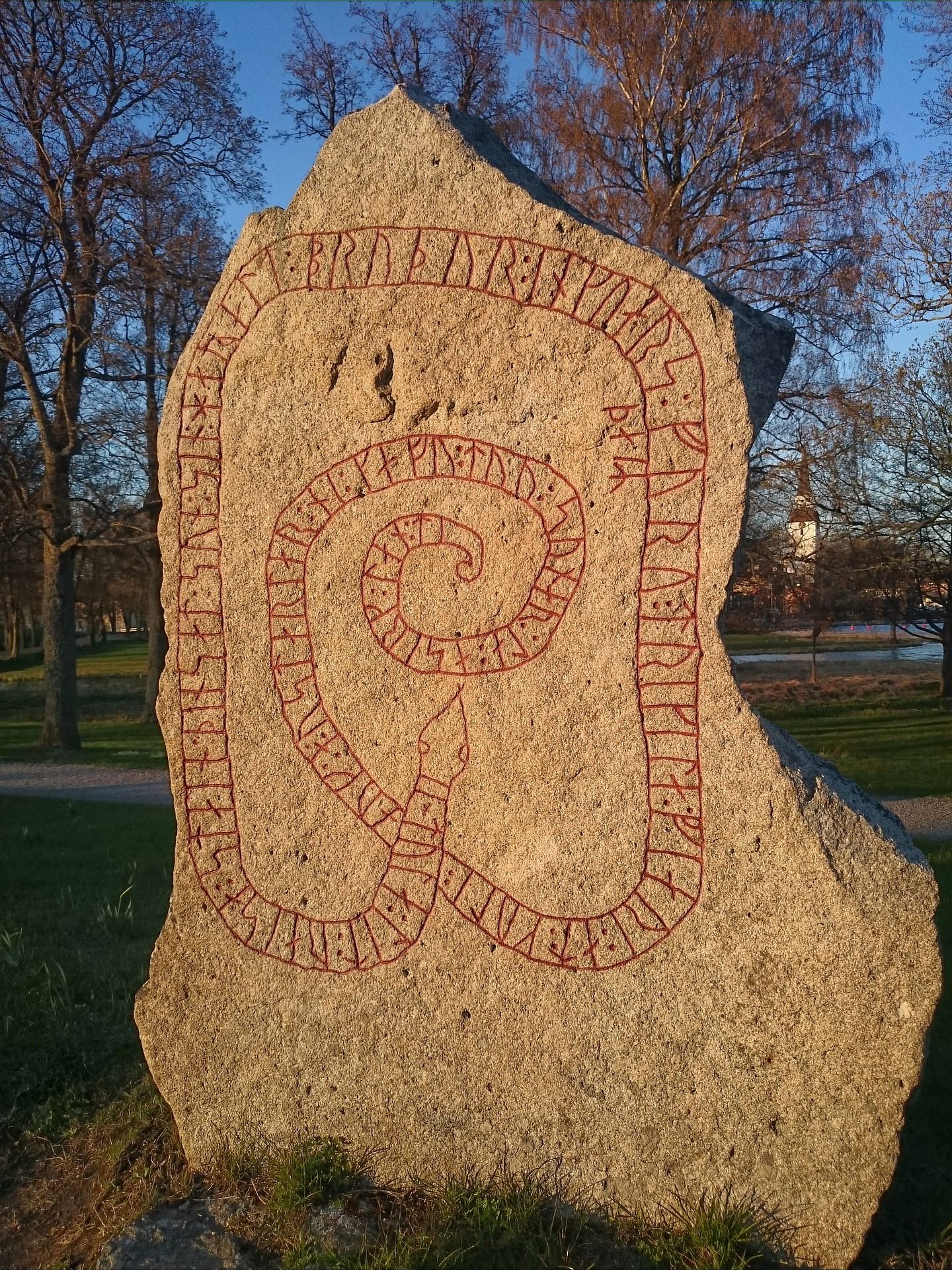
With the runes, the phonosemantic perspective takes on an additional layer of significance. Not only is the relationship between the definition of a word and the phonemes that comprise it inherently meaningful – the relationship between a phoneme and its graphic representation is inherently meaningful as well.
Thus, the runes were not only a means of fostering communication between two or more humans. Being intrinsically meaningful symbols that could be read and understood by at least some nonhuman beings, they could facilitate communication between humankind and the invisible powers who animate the visible world, providing the basis for a plethora of magical acts.
In the verses from the Völuspá quoted above, we see that the carving of runes is one of the primary means by which the Norns establish the fate of all beings (the other most often-noted method being weaving). Given that the ability to alter the course of fate is one of the central concerns of traditional Germanic magic, it should come as no surprise that the runes, as an extremely potent means of redirecting fate, and as inherently meaningful symbols, were thereby inherently magical by their very nature. This is a controversial statement to make nowadays, since some scholars insist that, while the runes may have sometimes been used for magical purposes, they were not, in and of themselves, magical.
But consider the following episode from Egil’s Saga. While traveling, Egil eats a meal with a farmer whose house is on the Viking’s route. The farmer’s daughter is dangerously ill, and he asks Egil for help. When Egil examines the girl’s bed, he finds a whalebone with runes carved on it. The farmer explains to Egil that these runes were carved by the son of a local farmer – presumably an ignorant, illiterate person whose knowledge of the runes could have only been flimsy at best. Egil, being a master of runic lore, readily discerns that this inscription is the cause of the girl’s woes. After destroying the inscription by scraping the runes off into the fire and burning the whalebone itself (!), Egil carves a different message in different runes so as to counteract the malignancy of the earlier writing. After this has been accomplished, the girl recovers.
We can see from this incident that the heathen northern Europeans made a sharp distinction between the powers of the runes themselves, and the uses to which they were put. While the body of surviving runic inscriptions and literary descriptions of their use definitely suggest that the runes were sometimes put to profane, silly, and/or ignorant purposes, the Eddas and sagas make it abundantly clear that the signs themselves do possess immanent magical attributes that work in particular ways regardless of the intended uses to which they’re put by humans.